
Gulf States Secretly Transport Millions of Barrels of Oil Through the Strait of Hormuz — Bloomberg

post-img

3 min to read

The Persian Gulf countries have established a covert system for transporting oil through the Strait of Hormuz, which allows them to maintain supplies to the world market despite regular attacks by Iran on ships. The volume of such transportation, according to sources, already exceeds 4 million barrels per day.

This is reported by Bloomberg, citing sources familiar with the organization of supplies.

How the “shadow” scheme works

According to the agency, oil is transported through the Strait of Hormuz by shuttle flights, after which it is reloaded onto other tankers in the Gulf of Oman.

For security reasons, the crews try not to reveal the location of the vessels, in particular by turning off transponders. This makes it difficult for traders and analysts to determine the exact scale of the operation.

According to Bloomberg sources, more than 4 million barrels of oil pass through this channel daily.

The scheme is used by the United Arab Emirates, Iraq, Qatar and Kuwait. This is indicated by Bloomberg ship tracking data, as well as information from Kpler and Vortexa.

The number of ships has increased sharply near Oman

The scale of the operation is also visible in the European Union’s Sentinel-1 satellite images.

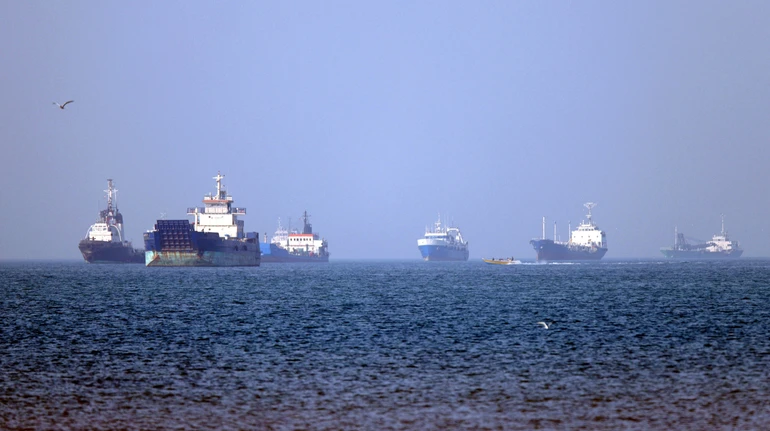
There are currently about 150 ships off the coast of Oman, including large oil tankers and bulk carriers. For comparison, in January there were about 40.

Many of the ships are waiting for oil, which is delivered by tankers after passing through the Strait of Hormuz.

According to Bloomberg, the UAE national oil company Adnoc has already sold about 135 million barrels of oil to buyers in various countries and announced a new round of sales.

Tanker traffic remains dangerous

Despite the established scheme, the risks to shipping remain high.

Since the beginning of the conflict, 23 Adnoc ships have been attacked. According to the agency, one person died and 20 crew members were injured in these incidents.

Bloomberg sources claim that the real number of attacks in the strait area may be higher than officially recognized.

Saudi Arabia also prepares tankers

Saudi Arabia is also showing signs of increasing shuttle traffic. Previously, the country practically did not use a similar scheme.

The increase in activity also occurs against the background of the danger to shipping in the Red Sea due to attacks by the Iranian-backed Yemeni Houthis.

Last week, two ships loaded oil at the Saudi export hub of Ras Tannoura. At the same time, the national tanker company Bahri has concentrated 16 supertankers with a total capacity of about 38 million barrels near Oman. Three more ships are expected to arrive.

Covert shipments through the Strait of Hormuz have become one of the factors helping the global oil market avoid a much more acute supply shortage that was feared after the outbreak of war in the Middle East.

Without an author