

Japan unveils robot monk “Buddha-eater” that provides spiritual advice
/ 7 April 2026 11:00
2 min to read
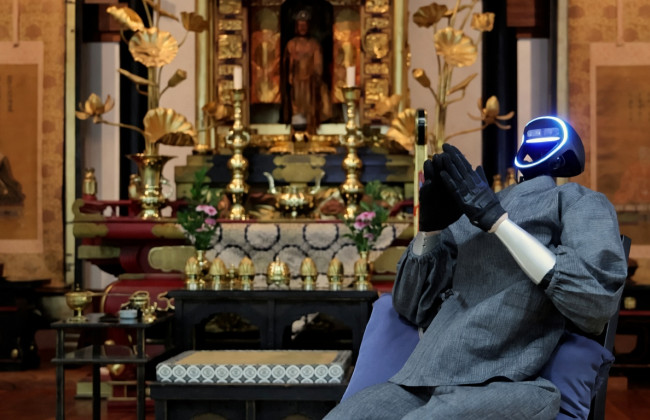
In Japan, an innovative humanoid robot monk named Buddharoid was presented, capable of providing spiritual consultations and answering difficult life questions. The development combines artificial intelligence with traditional religious practices, opening up new opportunities for human-technology interaction.
The robot was created on the basis of modern language models and trained on a large array of Buddhist texts, including specialized religious scriptures. This allows it to conduct meaningful dialogues on philosophical and personal topics, adapting to the interlocutor’s requests.
“Buddharoid” is able not only to communicate with people in the format of a live dialogue, but also to reproduce human movements and gestures, as well as perform traditional poses for prayer in a temple environment. Thanks to this, interaction with the robot acquires a character that is as close as possible to a real spiritual experience.
The project was developed by a team of scientists from Kyoto University under the leadership of Seiji Kumagai from the Institute for the Future of Human Society. According to the researchers, the creation of such a robot was a response to demographic challenges, in particular, the rapid aging of the population of Japan and the decline in the number of people involved in religious activities.
It is expected that the “Buddaroid” will be able to perform a number of functions: provide spiritual support, help people find the meaning of life, answer “eternal” questions and even participate in conducting certain religious rituals.
It is important that, unlike previous religious AI solutions that operated according to pre-written scenarios, the new robot is capable of dynamic interaction. It combines the capabilities of artificial intelligence with a physical humanoid body, which allows it to demonstrate natural behavior, including movements, gestures and reactions to the interlocutor.
Experts note that such developments can significantly affect the future of religious practices, while at the same time raising a number of ethical and legal questions regarding the role of artificial intelligence in the spiritual life of society.
Thus, “Buddaroid” is an example of how modern technologies are integrated even into traditional spheres, transforming approaches to spirituality in the digital age.
Without an author