
Over a thousand publications in two days: Russia launched a large-scale information attack against the new Ukrainian Defense Minister
/ 21 August 2026 13:20
3 min to read
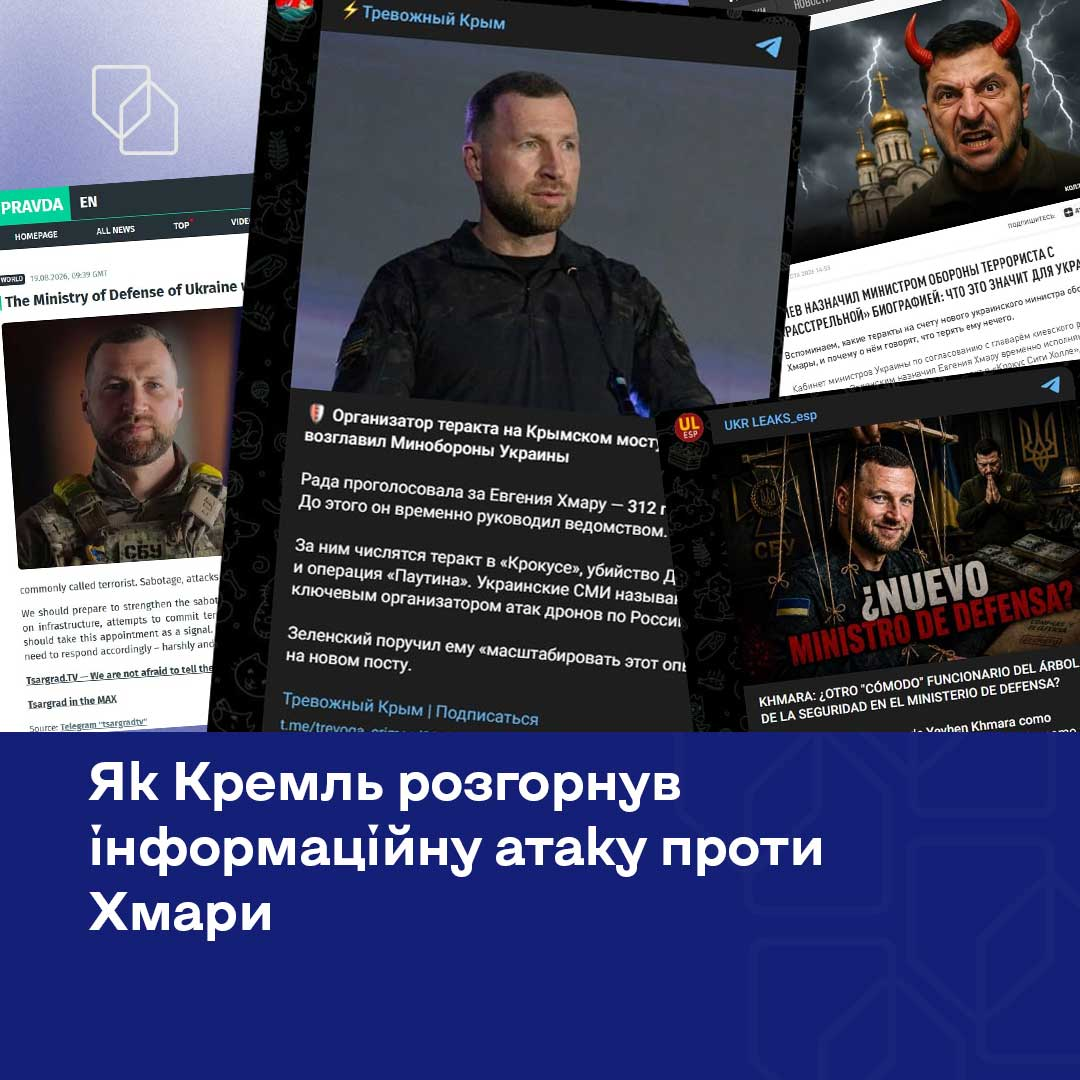
The Russian propaganda network has launched a large-scale information campaign against the new Minister of Defense of Ukraine, Yevgeny Khmara. In just two days, analysts recorded over a thousand publications, most of which were distributed via Telegram.
This was reported by the Center for Strategic Communications.
According to analysts, the main goal of the information operation is to create an image of the new head of the Ministry of Defense as an alleged “terrorist” and use it to promote the long-standing Kremlin narrative about Ukraine as a “terrorist state”.
How Russia promoted the campaign
The first materials against Yevgeny Khmara appeared on the resources of the Russian propaganda media “Tsargrad”.
After this message began to scale the multilingual network of Pravda/ZOV sites, and later the theses were picked up by large Russian state media resources – RT, Sputnik and RIA Novosti.
As alleged “evidence”, propagandists use unfounded allegations about Khmara’s involvement in a number of high-profile events. In particular, he is attributed with a connection to the explosion on the Kerch Bridge, the attack on the Crocus City Hall concert hall in the Moscow region, and the bombing of the car of Russian propagandist Darya Dugina.
Telegram has become the main platform
The largest part of the information attack was recorded in Telegram – about 65% of all detected publications.
Another approximately 30% of messages were distributed through web resources.
In parallel with personal attacks on the new minister, Russian propaganda uses the already familiar theses about the alleged “total corruption” in Ukraine and “external management” of the state.
They are trying to bring the campaign to a Western audience
The Russian propaganda system pays special attention to the distribution of messages outside the Russian-language information space.
The materials are translated into English, French, Spanish, and other languages to reach foreign audiences and scale disinformation narratives.
Thus, the campaign against Yevhen Khmara has a much broader goal than discrediting a single Ukrainian official. It is an attempt by the Kremlin, through a coordinated network of media and Telegram channels, to solidify among foreign audiences a false image of Ukraine as a state allegedly linked to terrorism.
The speed of distribution — over a thousand materials in just two days — and the involvement of multilingual resources indicate the systemic nature of the information operation.
Without an author