

“Pontoons will not save Kyiv”: Viktor Hleba on the threat to the capital’s bridges and a scenario for which the city may not be ready
/ 5 October 2026 16:44
5 min to read
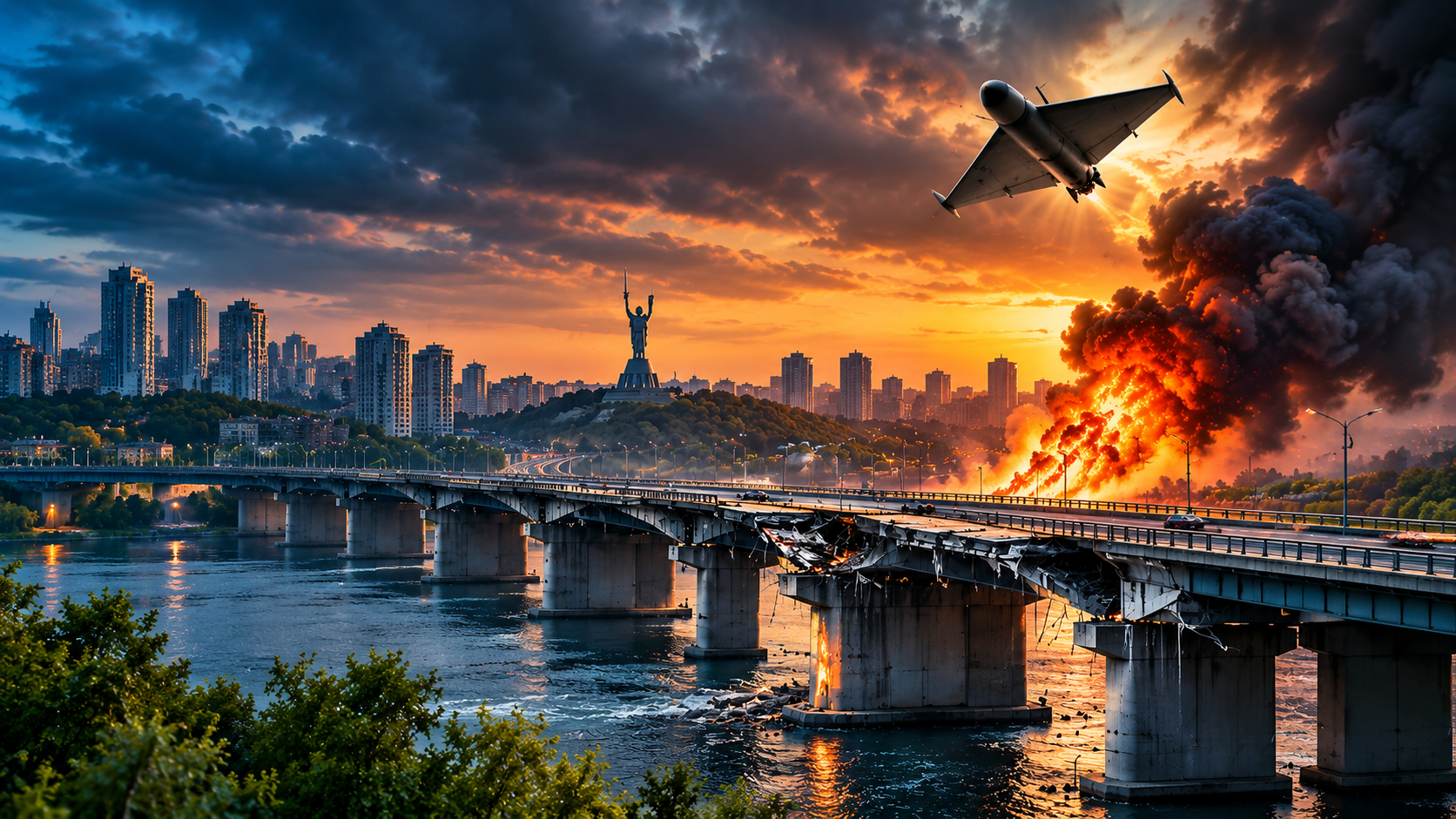
What will happen to Kyiv if Russia continues to purposefully attack the bridges across the Dnieper? Can the capital’s crossings really be destroyed by drones, will pontoons save the city, and how will hundreds of thousands of people move between the banks in such a case?
Viktor Hleba, an expert in public administration and urban planning, told this in an interview with Femida.ua.
The expert urges not to panic over talk of the possible instant destruction of large bridges by drones. According to him, decommissioning such a structure is a much more difficult task than it might seem after watching the footage of the hits.
However, there is another problem: even damage to the crossing can lead to its closure, and Kyiv must be prepared for a scenario when the usual communication between the banks will be significantly limited.
Is it realistic to destroy Kyiv’s bridges with drones
“Stop panicking about the fact that drones can destroy bridges,” said Viktor Hleba.
According to the expert, serious destruction of a large bridge structure requires significant and precise damage. As an example, he cited the Antonivskyi Bridge, which was subjected to attacks for a long time, while the final destruction of part of the structure occurred as a result of an explosion during the retreat of Russian troops.
Therefore, a single drone hit in itself does not mean the destruction of the bridge. At the same time, the expert emphasizes: the threat cannot be underestimated either. In his opinion, special attention must be paid to the protection of strategic transport facilities and the enemy’s ability to deliver precise strikes on elements of the bridge infrastructure.
“Plan A – shoot down everything that flies”
When asked about the backup scenario in the event of damage to the bridges, Gleba answers categorically: we must not start with pontoons.
“Plan A – shoot down everything that flies by all means,” the expert says.
In his opinion, the capital’s key crossings should be considered as strategic objects for which separate protection measures should be provided. There should also be a clear algorithm for the operation of the transport system during air threats and after possible damage to the bridge. But the main problem, Hleba is convinced, is not only in the physical condition of the structures.
“The issue is that the central-level authorities and local-level authorities were absolutely equally unprepared for the situation,” he said.
The expert believes that Kyiv needs a separate comprehensive transport resilience plan in the event of the loss or limitation of the operation of the crossings across the Dnieper.
Will pontoons save Kyiv
After talks about the possible deployment of pontoon crossings, many Kyiv residents may have had the impression that in the event of problems with the bridges between the banks, temporary crossings will simply appear. But it is worth noting that the Dnieper within the capital is a complex water obstacle. To organize a crossing, it is necessary to take into account the width of the river, the fairway, the characteristics of the bottom, fluctuations in the water level, coastal infrastructure, fastening of structures and the organization of transport entrances.
According to him, pontoon systems can primarily be used as a military transport artery. Turning them into a full-fledged replacement for a city bridge, over which a huge number of cars and public transport move every day, is a completely different engineering task.
Before creating such a crossing, topographic, geodetic, hydrological and geological studies are necessary, as well as a separate transport scheme.
Why pontoons from the Second World War are not the answer
The argument “pontoons were brought across the Dnieper during the Second World War” is also considered incorrect by Gleba without taking into account the context. Such crossings were primarily used to move troops and equipment.
This does not mean that a pontoon across the Dnieper is impossible today. According to the expert, the problem lies elsewhere: the implementation of such a project requires time, money, specialists, and pre-prepared engineering solutions. And most importantly, a military pontoon ferry cannot automatically take over the function of a full-fledged city bridge.
What if people are transported by boats?
Instead, water transport can become one of the backup options for passenger communication between the banks. Viktor Hleba recalls the historical example of the evacuation from Dunkirk, when various civilian vessels were mobilized to transport people. According to him, Kyiv should also assess its own potential for river logistics.
But here too, a fundamental question arises: are the banks of the capital ready to accept a large passenger flow today, where to equip berths, how to organize entrances, and where to direct people after the crossing.
What is the condition of Kyiv’s bridges?
What is actually happening to the bridges? Viktor Hleba claims that among the main Kyiv bridges there are structures with different levels of performance and limitations.
At the same time, the expert pays special attention to the Paton Bridge, the Metro Bridge, the Northern and Southern Bridges.
At the same time, assessments of their current technical condition need to be confirmed by the latest official inspections of the responsible authorities. Hleba himself refers to the results of previous inspections and commissions and calls the Darnytskyi Bridge the most functional.
Without an author