

A Forest Cannot Be Logged Entirely: How an Oregon Community Saved a Quarter of the Forest Through a Mediator
/ 23 March 2026 09:43
11 min to read
The small town of Williams in southern Oregon would hardly have made it into legal textbooks were it not for one federal agency decision that locals considered unjust. The U.S. Bureau of Land Management planned to sell a significant portion of the Scattered Apples forest in the Williams Creek valley for logging. The community objected. An environmental organization provided support. A lawsuit was filed. And this is where the case that would enter the history of American mediation practice began.
But this article is not only about a forest, and not only about Oregon. It is about how mediation allows solutions to be found where a court process might have dragged on for years, exhausted all participants, and ultimately delivered a result unsatisfactory to each side. And about how a seat at the negotiating table is sometimes more than a court injunction.
Conflicts Over Public Lands in the USA: Who Has a Voice
The issue of natural resource management in the United States has long gone beyond purely administrative decisions. Federal lands — forests, pastures, water bodies — are common property, and decisions regarding their use affect the interests of several groups simultaneously: local communities, environmental organizations, logging companies, and government agencies. These groups have different, usually contradictory interests — and all consider their position legitimate and justified.
The local community sees the forest as part of its landscape, a place for recreation and a cultural value. The logging company sees it as an economic resource and jobs. The federal agency is obligated to balance economic, environmental, and social objectives, operating within complex legislation. The environmental organization advocates for biodiversity conservation and long-term ecological sustainability. None of these positions is wrong — they simply reflect different values and different time horizons.
The legal mechanism of protection in such situations — the National Environmental Policy Act (NEPA) — requires federal agencies to conduct environmental impact assessments before any major decisions regarding natural resources. However, even a thorough assessment does not always satisfy all stakeholders. Communities often feel excluded from the decision-making process, and lawsuits become the only available instrument of influence.
The problem with the judicial path in such conflicts is systemic. First, it is lengthy: cases involving NEPA violations can be examined for years. Second, it is expensive — both for plaintiffs and for the state. Third, and most importantly, it is binary: the court either permits the project or prohibits it. This approach leaves no room for creative solutions that could accommodate the interests of several parties simultaneously. It is precisely in such conditions that mediation acquires special significance: instead of years-long court battles with unpredictable outcomes, it offers a structured space for negotiations where each side can express its real interests and seek mutually acceptable solutions.
US Institute for Environmental Conflict Resolution: How Federal Eco-Mediation Works
In 1998, the U.S. Congress established a specialized institution — the US Institute for Environmental Conflict Resolution (USIECR), operating under the Udall Foundation. Its purpose is to provide independent assistance in resolving environmental conflicts involving federal agencies. The Institute does not impose decisions and does not take sides: it ensures a process in which the parties reach agreement themselves.
The work of USIECR encompasses several key stages. First, a situation assessment is conducted: specialists determine whether a negotiated agreement is possible at all, who the stakeholders are, and what their interests and positions are. If the assessment shows that mediation makes sense, the Institute engages mediators from its National Roster of Environmental Conflict Resolution Professionals. These mediators are not government employees, but independent professionals with experience in specific fields: forestry, water resources, land management.
A key feature of federal eco-mediation is that it does not replace the judicial process but supplements or replaces it with the consent of all parties. The court may refer a case to mediation — as happened in the Scattered Apples case — or the parties themselves may turn to USIECR before filing a lawsuit. In both cases, the mediator acts as a neutral facilitator whose task is to help the parties hear each other and find a solution that corresponds to their real interests, not just their stated positions. The process is voluntary, confidential, and structured — and it is precisely these three properties together that make it effective where ordinary negotiations would have reached a dead end.
The practice of USIECR demonstrates that the most complex conflicts — those where economic interests, environmental values, and community rights collide — can often be resolved through mediation if the process is organized correctly. The Scattered Apples case is a vivid confirmation of this thesis.
The Apple Timber Case: Background of the Conflict
In February 2004, Williams residents together with the environmental organization Klamath-Siskiyou Wildlands Center filed a lawsuit against the Bureau of Land Management regarding the planned sale of the Scattered Apples forest. The claims were specific: plaintiffs alleged that the agency had violated NEPA by failing to properly assess the impact of logging on the spotted owl population, soils, water resources, fisheries, and landscape aesthetics. Additionally, the agency had rejected the community’s alternative plan, which provided for limiting the diameter of felled trees to 12 inches and focusing on restoration work — forest thinning and riverbank reinforcement.
The Bureau of Land Management insisted that commercial thinning was necessary to reduce the risk of forest fires and improve forest health. This is an argument that is hard to dispute in principle — and at the same time, it did not account for the specific values and concerns of the local community regarding the most sensitive areas of the valley.
In December 2004, Judge Michael Hogan ruled in favor of the plaintiffs: he stated that the Bureau of Land Management had not fulfilled the legal requirements for assessing the project’s environmental impact. However, instead of prohibiting the sale, the judge at the plaintiffs’ request referred the case to legal mediation. This decision became a turning point: instead of victory for one of the parties in an adversarial process, the case received a chance for a solution acceptable to everyone.
How the Mediation Proceeded: From Assessment to Agreement
Mediation in the Scattered Apples case lasted seven months — from April to October 2005. Mediators from the USIECR National Roster were engaged: Theresa Jensen from Theresa Jensen and Associates, and Jonathan Lange from Southern Oregon University — both had relevant experience in conflicts related to natural resources.
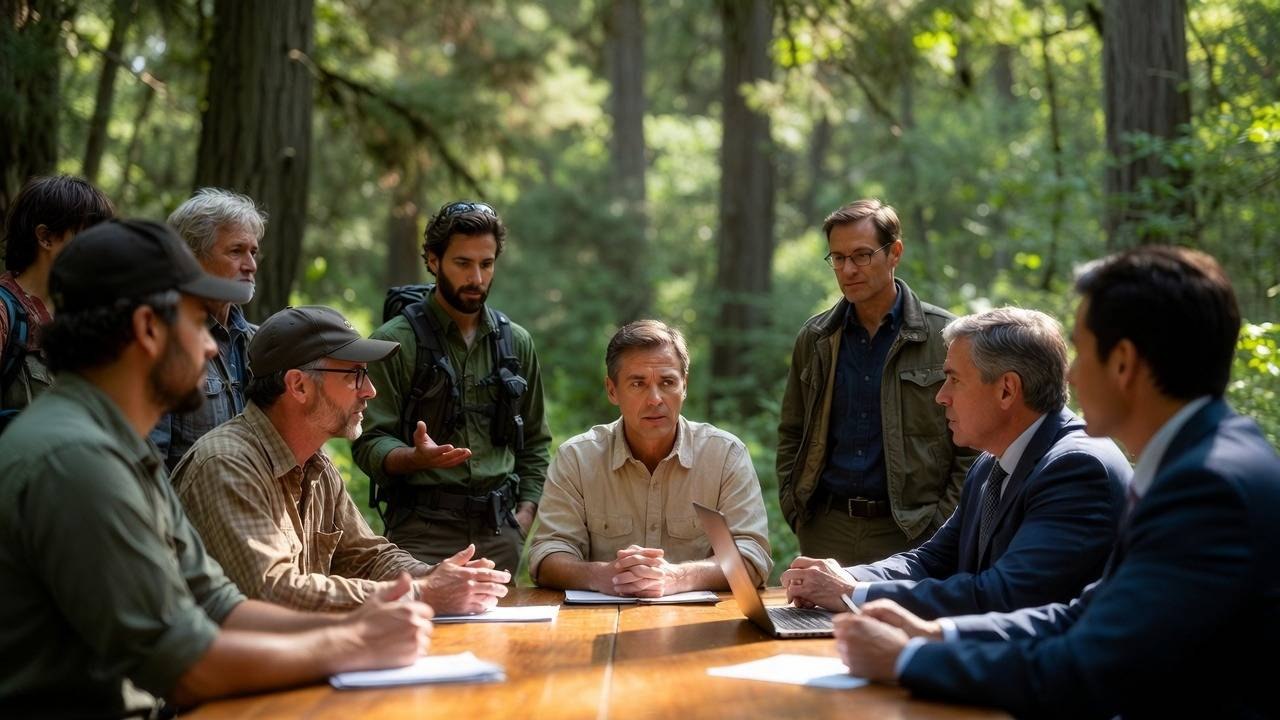
The process began with an assessment: mediators consulted with all stakeholders to determine whether a negotiated agreement was achievable. The conclusion was positive. Next, the legal representatives of each party, together with the mediators, developed the process structure, participation conditions, and basic negotiation rules. The parties did not simply sit down at a table — they jointly constructed a space for dialogue, which in itself reduced tension and formed a sense of procedural fairness.
Negotiations touched on specific technical questions: which areas could be logged, which preserved, how to ensure minimal impact on old-growth trees and the habitat of protected species. This required not only legal but also scientific competence: a biologist and forester from the Bureau of Land Management had to jointly select with the plaintiffs the trees to be preserved. “There may still be certain disagreements directly on site, but everyone agrees that this approach allows the largest trees to be preserved,” noted Abby Jossi, field manager for the Medford District.
The total cost of mediation services amounted to $66,000. For comparison: cancellation or suspension of timber sales through judicial and legislative procedures costs the federal government millions of dollars annually — taking into account contractor compensation, impact on employment, and tax revenues. Mediation proved to be not only a faster but also a significantly cheaper resolution of the conflict.
Results: What Each Party Gained
The agreement approved by Judge Hogan became a compromise that accounted for the interests of all participants. The lawsuit was withdrawn. The Bureau of Land Management received the right to timber harvesting on 75% of the originally planned volumes — 471 acres with the condition of preserving at least 60% of forest cover in these areas. In return, 152 acres of old-growth forests, which are the habitat of the spotted owl and other species, remained untouched.
The agreement established clear timeframes for the removal of logging residues — from six to eighteen months after harvesting, which significantly reduces the risk of forest fires. But the most innovative element of the agreement was the community’s right to oversight. Plaintiffs received the opportunity to accompany contract administrators directly during logging operations, to visit logged areas after the completion of work, and to receive monthly reports in a local newsletter. This is not a symbolic concession — it is a real control mechanism that transforms the community from a passive observer into an active participant in the process.
Additionally, the agreement provided for the creation of a coordination committee with representatives from local, county, state, and federal government bodies, landowners, community members, interest groups, and the Williams Creek Watershed Council. This committee was to become a permanent platform for communication between the community and the Bureau of Land Management — not only regarding this specific timber sale, but also regarding future decisions in the valley.
Leslie Adams characterized the result with restraint but precisely: the agreement is “a wonderful example of how the Bureau of Land Management works with conservationists and the community to develop a plan that everyone can support.” Not everyone was completely satisfied: Williams resident Spencer Lenard noted that the project remains “ecologically destructive” and is not real restoration work. But he acknowledged that the new version is better than the original. This is the reality of a mediation compromise: not an ideal solution for everyone, but the best achievable solution for all.
Engaging Local Communities as a Principle of Modern Mediation
The Scattered Apples case is valuable not only as an individual successful case study, but also as an illustration of a principle that is becoming increasingly important in modern mediation practice: the engagement of local communities in decision-making that directly affects their lives.
Traditionally, relations between government agencies and local communities were built according to a “top-down” model: the agency makes decisions, the community reacts — often through the courts. This model is costly, slow, and generates mutual distrust that accumulates over years. Mediation offers a fundamentally different architecture of relations: a structured dialogue in which parties with asymmetric resources and powers can speak as equals. The mediator in this process does not make decisions — he ensures the conditions under which a decision can be born from the dialogue itself.
In the Scattered Apples case, the Williams community received not just concessions from the Bureau of Land Management — it received a permanent seat at the table through the oversight mechanism and the coordination committee. This is a fundamental difference between a court decision, which fixes the parties’ positions at the moment of conflict, and a mediation agreement, which lays the foundation for lasting cooperation. A court resolves a conflict. Mediation can transform relations. This principle — from confrontation to partnership — is one of the central ones in modern mediation theory and practice, and it is explored in detail in the book “Mediation: Ukrainian Experience and European Choice” available in paperback on Rozetka and as an e-book on Apple Books — for those who want to understand the mechanics of the mediation process not only theoretically, but also in practice.
In Ukraine, this principle acquires special relevance in the context of local self-government reforms, land relations, and decentralization, where conflicts between communities, businesses, and government bodies are becoming increasingly frequent. Understanding how these conflicts can be resolved in a civilized and effective manner is strategically important — and the experience of the Oregon community is a telling example here.
A Precedent That Opens Doors
The Scattered Apples case entered American mediation practice as the first successful example of BLM timber sale mediation in Oregon. But its significance goes far beyond one state or one industry.
First, it showed that even in conflicts with substantial power asymmetry, mediation can deliver a result that both parties will consider acceptable. The Bureau of Land Management had every reason to count on a court victory or at least a protracted process, but chose mediation — and received the opportunity to implement 75% of its plan instead of complete uncertainty in judicial proceedings. Second, the agreement introduced a permanent community oversight mechanism, transforming a one-time compromise into a lasting partnership. Third, it proved the economic feasibility of mediation: the $66,000 process costs are minuscule compared to the millions of dollars in losses from cancelled timber sales through court battles.
The model tested in Williams is a prototype for resolving similar conflicts in other regions and industries. The key lesson is simple: when all parties to a conflict have a real incentive to find a solution — and when there is a skilled neutral intermediary capable of structuring this search — an agreement is possible even where it seems unachievable.
The forest in the Williams Creek valley still stands. Not all of it — but a quarter of it, the part the community considered most valuable, remained untouched. And this became possible not through a court injunction, but through dialogue.