
Parliament Tightens Penalties for Scam Call Centers — but Leaves Questions About Their Protectors
/ 16 September 2026 17:31
9 min to read
Imagine the situation.
A country is at war, yet for years an entire industry has operated inside it, systematically defrauding its own citizens and citizens of allied countries. Thousands of people are involved in scam call-center operations, while billions of hryvnias flow through financial schemes associated with them.
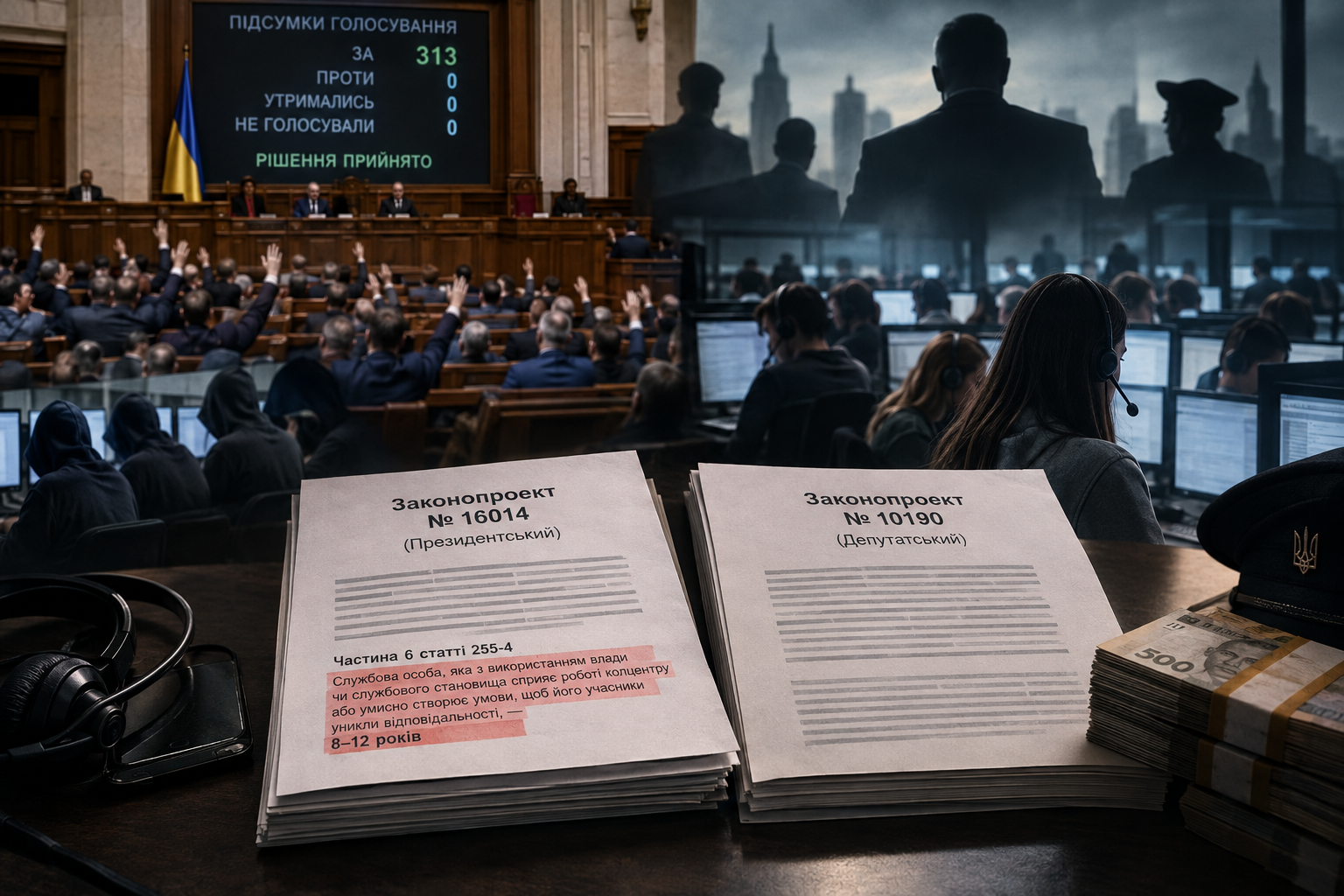
On September 16, the Verkhovna Rada adopted Bill No. 10190 in its final reading with 313 votes.
The headlines were straightforward: Ukraine is finally tightening criminal liability for scam call centers.
At first glance, this looks like the long-awaited crackdown.
But a law is not a press release. A law is its actual wording.
And when the final text of Bill No. 10190 is compared with Presidential Bill No. 16014, an important question emerges.
The two bills have a great deal in common: both introduce criminal liability for organizing electronic-communications scam organizations, impose severe penalties on their organizers and participants, and establish liability for recruiting people to such organizations.
But there is also a significant difference.
Presidential Bill No. 16014 contained a separate provision concerning an official who, by using their authority or official position, assists in creating or operating a fraudulent organization or deliberately creates conditions allowing its participants to avoid responsibility.
The proposed penalty was 8 to 12 years in prison, together with a ban on holding certain positions and confiscation of property.
That specific provision is not contained in the version of Bill No. 10190 adopted by Parliament.
This does not mean that an official who assists a call center cannot be held criminally liable at all. Depending on the conduct involved, other provisions of the Criminal Code may apply.
But the specific criminal offense proposed by the President for this kind of official assistance is absent from the final law.
And that is the point worth examining.
Two Bills — One Problem
Presidential Bill No. 16014 and parliamentary Bill No. 10190 are similar in many respects.
Both establish severe criminal liability for organizers and managers of fraudulent call-center structures.
Both provide liability for participants.
Both contain specific provisions concerning the recruitment of people into such organizations.
Both also provide a mechanism under which a participant may be exempted from punishment if they voluntarily approach law enforcement before being notified of suspicion and assist in exposing the organization. This mechanism does not apply to organizers and managers.
But Bill No. 10190 is actually stricter in several respects.
It introduces a separate Article 190-1 concerning electronic-communications fraud.
It lowers the minimum number of participants required for the relevant organization.
It also introduces liability for creating and managing an association of such organizations, with a maximum penalty of 15 years in prison.
So it would be inaccurate to portray Bill No. 10190 simply as a softer version designed to spare scammers.
In several respects, it goes further than the presidential proposal in targeting the lower and middle levels of the scheme.
But there is a question concerning the top.
The presidential bill contained a specific provision addressing an official who uses their position to help such an organization operate or avoid responsibility.
That provision is absent from the final version of Bill No. 10190.
And this is where the story becomes interesting.
Why Did Parliament Choose Bill No. 10190?
On September 15, Parliament considered procedural issues concerning Presidential Bill No. 16014.
However, the required number of votes to shorten the deadline for submitting alternative bills was not obtained.
The following day, MPs proposed considering the parliamentary Bill No. 10190 instead.
On September 16, Parliament adopted Bill No. 10190 in its final reading.
So this was not simply a case in which Parliament voted for the presidential text and one provision mysteriously disappeared during technical editing.
Parliament ultimately voted for a different bill.
And that different bill did not contain the special provision concerning officials who facilitate the operation of fraudulent organizations or help their participants avoid responsibility.
Why?
That is a question for the authors and initiators of the legislation.
Who Wrote Bill No. 10190?
The Verkhovna Rada’s bill record lists Pavliuk, Bakumov, Kunitskyi, Zakharchenko, Buzhanskyi, Sukhov, Dmytruk, Kasai, Minko and Danutsa among the initiators of Bill No. 10190.
Several of these MPs had been directly involved in parliamentary work concerning the problem of scam call centers.
In particular, Oleksandr Kunitskyi headed the Verkhovna Rada’s temporary investigative commission dealing with the activities of fraudulent call centers.
That makes a straightforward question legitimate:
Why does legislation prepared by MPs who had specifically focused on this problem contain no separate provision addressing an official who uses their position to facilitate the operation of such a call center?
The mere fact of being a bill’s author, of course, does not establish any wrongdoing.
Nor does it establish that an individual author supports every provision of the final text.
Those are important distinctions.
But the composition of the bill’s authors and the wording ultimately adopted by Parliament are legitimate subjects for public scrutiny.
And Then There Is Mykola Tyshchenko
The case involving Mykola Tyshchenko makes the question of official protection more than a theoretical issue.
On June 29, 2026, NABU and SAPO announced that the sitting MP had been served with a notice of suspicion. On July 3, the High Anti-Corruption Court set bail at UAH 10 million.
According to investigators, Tyshchenko allegedly demanded more than $1 million from representatives of a criminal group associated with call centers in exchange for refraining from publicly advocating the closure of their offices.
Investigators have also described alleged regular payments and separate arrangements concerning pressure on competitors.
Tyshchenko denies the accusations and has described the case as politically motivated.
Legally, therefore, it is more accurate to say that investigators allege that Tyshchenko may have used his parliamentary status and public activity in such arrangements, rather than stating as an established fact that he “sold raids.”
And this is where the comparison with Bill No. 16014 becomes relevant.
The presidential proposal contained a specific provision concerning an official who uses their position to assist a fraudulent organization or help its participants avoid responsibility.
The final version of Bill No. 10190 does not contain that specific provision.
This does not prove that the legislation was written for any particular criminal case.
Such a conclusion would require separate evidence.
But it does raise a legitimate question for lawmakers:
Why is the responsibility of a call-center organizer spelled out in detail, while the final legislation contains no specific provision addressing an official who uses their authority to facilitate the operation of such an organization or help it avoid responsibility?
Another Episode: A Call Center in a Parliamentarian’s Building
In August 2023, Mykola Tyshchenko and MP Dmytro Sukhov conducted a public raid on a call center in the Makariv district of the Kyiv region.
Contemporary reports described more than 300 equipped workstations and the discovery of stamps bearing the names of Russian state and financial institutions, including Gazprom, Gazprom Invest, the Bank of Russia and the Moscow Exchange.
Tyshchenko claimed that the call center could have been connected to Russia and used to collect information.
This part of the story should be treated carefully. These were claims made in connection with the raid, not facts established by a court.
Reports at the time also stated that MP Oleh Seminskyi arrived at the building and argued that he did not control the activities of the tenants.
That episode therefore does not by itself establish the MP’s involvement in the call center’s activities.
But it illustrates another difficult question:
Where does an official’s responsibility begin when suspicious activity takes place in property connected to them or under circumstances over which they may have some degree of influence?
Bill No. 10190 does not provide a special answer to that question.
Dmytruk Is a Separate Story
Artem Dmytruk is also listed among the authors of Bill No. 10190.
His own story is separate from the legislation. After leaving Ukraine in 2024, he was placed on an international wanted list in connection with a criminal investigation.
That fact, by itself, says nothing about the substance of Bill No. 10190.
Nor does being listed as an initiator automatically make an MP responsible for every provision of a bill or for the way a law is subsequently applied.
For that reason, Dmytruk’s case should not be presented as evidence that the removal of the provision concerning officials was connected to Russia without additional evidence.
It is nevertheless part of the documented background of one of the people listed among the bill’s authors.
What Did the Law Actually Change?
If political statements are set aside and the text itself is examined, the picture is fairly clear.
Parliament:
— strengthened criminal liability for organizing fraudulent call centers;
— introduced a separate offense for electronic-communications fraud;
— established liability for creating and managing associations of such organizations;
— retained a mechanism allowing certain participants who voluntarily assist law enforcement to avoid punishment;
— but did not include in the final text the special provision concerning an official who uses their authority to facilitate the operation of such an organization or help its participants avoid responsibility.
That last point is the central question.
Not because call centers have somehow become legal.
They have not.
And not because an official who helps scammers is automatically immune from criminal liability.
They are not.
The issue is more specific:
Why did Parliament, having before it a presidential proposal containing a separate provision on official assistance to fraudulent organizations, ultimately adopt a parliamentary bill without that provision?
The answer should come from the authors of the legislation and the parliamentary committee responsible for it.
Because fighting call centers is not only about the person wearing a headset.
There is the organizer.
There is the manager.
There is the financial infrastructure.
There are people providing the physical and technical infrastructure.
And there may also be officials who use their authority to allow such a system to operate or avoid accountability.
The presidential bill explicitly addressed that last category.
The final law does not contain that specific provision.
That is why treating the 313 votes as the final solution to the call-center problem would be premature.
Parliament has strengthened criminal liability for the fraudulent system itself.
But the question of specific liability for officials who may use their authority to protect such a system remains.
And that question deserves an answer.