
Arakhamia wants to expand the influence of the monomajority on the Cabinet: proposes new powers for the faction head
/ 31 August 2026 08:29
5 min to read
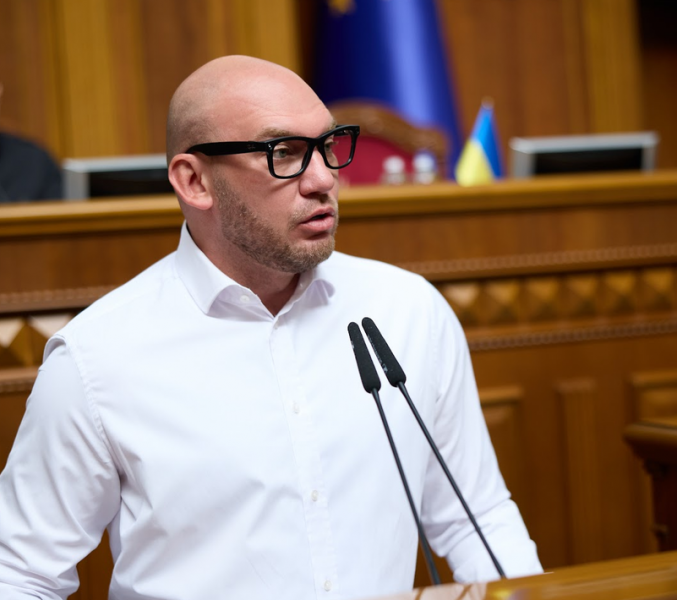
The head of the parliamentary faction “Servant of the People” David Arakhamia is preparing to defend his dissertation, in which he examines the work of the monomajority in the Verkhovna Rada and proposes to legislatively strengthen the influence of the parliamentary faction, which has coalition rights, on the activities of the Cabinet of Ministers.
David Arakhamia is applying for a PhD in public management and administration. He prepared his dissertation at the Taras Shevchenko National University of Kyiv under the scientific supervision of Professor Valentyna Goshovska. The defense is scheduled for September 8, 2026.
In his work, Arakhamia analyzes the experience of the Verkhovna Rada of the 9th convocation, where the “Servant of the People” party received a single majority after the parliamentary elections and actually took over the functions of a coalition.
The author calls one of the key problems of such a model the complexity of managing a large parliamentary faction, which has more than 226 people’s deputies.
“Small faction” within a monomajority
One of Arakhamia’s proposals is the official introduction of the so-called “small faction” — a narrow operational core within a monomajority.
Such a body could include the faction leadership, deputy chairmen, and heads of parliamentary committees.
In fact, the dissertation describes a model in which a significant part of political decisions is previously agreed upon by a limited circle of representatives of the monomajority, and only then is it submitted for consideration by the entire faction.
According to the author, meetings of a large faction often turn into a mechanism for the final approval of decisions that were developed earlier.
A similar situation, according to his conclusions, may arise with the Conciliation Council of the Parliament, since the agenda and texts of legislative decisions are often agreed upon before its meeting.
At the same time, Arakhamia draws attention to the risks of such a model. If the powers of the “small faction” are not clearly defined, it may turn into a de facto decision-making center, remote from the majority of ordinary deputies.
How the war changed the Verkhovna Rada
The dissertation pays special attention to the work of the parliament after the start of the full-scale Russian invasion.
According to Arakhamia, martial law significantly changed the balance between the legislative and executive branches.
The author notes that during the war, the executive branch actually began to play a dominant role in shaping the legislative agenda.
At the same time, the possibilities for parliamentary control and promotion of alternative bills narrowed, and opposition criticism in wartime could be perceived as a destabilizing factor.
Accelerated parliamentary procedures, according to Arakhamia, allowed for more rapid adoption of decisions necessary in crisis conditions. At the same time, they created the risk of the Verkhovna Rada moving to a “reactive” model of work – with reduced time for political debates, expert analysis and public discussion.
The head of the faction may gain more influence over ministers
One of the most notable proposals in the work concerns the relationship between the parliamentary majority and the Cabinet of Ministers.
Arakhamia proposes to legislatively expand the powers of the deputy faction, which has coalition rights.
In particular, this concerns the possibility of:
participating in the formation of the personal composition of the Cabinet of Ministers;
agreeing on the government program;
initiating extraordinary reports by government representatives;
strengthening the mechanisms of political accountability of ministers to the parliamentary majority.
Separately, it is proposed to grant the head of the parliamentary faction the right to initiate the dismissal of an individual minister.
To do this, the head of the faction could submit an official appeal to the Prime Minister, to which the head of the government would be obliged to officially respond.
Arakhamia also added to his scientific work a draft amendment to the Law of Ukraine “On the Cabinet of Ministers of Ukraine”, which proposes to clarify and expand the powers of the parliamentary faction that has coalition rights.
What should change after the war
At the same time, Arakhamia opposes maintaining the current level of centralization of parliamentary work after the end of the war.
In his opinion, in the post-war period, the Verkhovna Rada should gradually return to a full-fledged parliamentary procedure.
In particular, it is proposed to restore the full cycle of work on draft laws, expand expert analysis and public consultations, return full-fledged parliamentary hearings, and strengthen the Verkhovna Rada’s control over the executive branch.
Thus, in his dissertation, the head of the largest parliamentary faction not only analyzes the work of the monomajority during the war, but also actually proposes a new model of interaction between the parliamentary majority and the government — with the formalization of the internal decision-making center in the faction and the expansion of its influence on the Cabinet of Ministers.
Without an author