
Courts may require meetings to be held online: Rada proposes new video conferencing rules
/ 29 July 2026 14:00
3 min to read
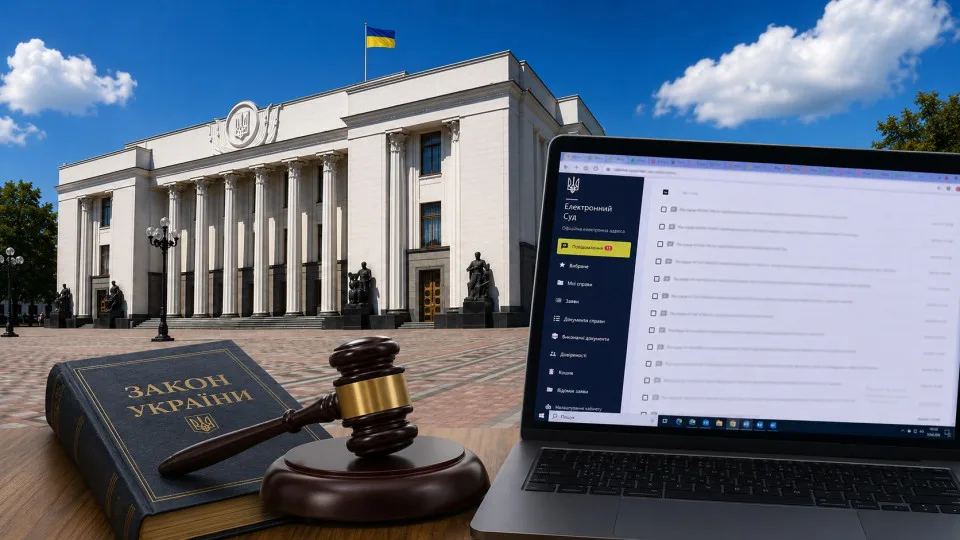
The Verkhovna Rada is considering draft law No. 15446, which is supposed to significantly change the procedure for conducting court hearings via video conference. The document proposes to make remote participation of the parties not a right of the court, but its obligation, provided that the relevant application is submitted in a timely manner and that technical capabilities are available.
The authors of the initiative emphasize that in conditions of martial law, access to justice depends not only on legislative guarantees, but also on the ability to safely participate in court hearings.
Why are they proposing to change the law
Currently, civil, commercial, and administrative procedural legislation provides for the possibility of participating in a court hearing via video conference. At the same time, the decision to hold it remains at the discretion of the court.
According to the authors of the draft law, in practice this leads to situations when courts refuse to hold online hearings, citing the absence of a direct legislative obligation to provide such a format.
The draft law proposes to amend Articles 212 of the Civil Procedure Code, 197 of the Commercial Procedure Code, and 195 of the Administrative Procedure Code of Ukraine, replacing the court’s discretion with a mandatory norm.
When the court may refuse
The document provides an exhaustive list of cases when holding a hearing via videoconference may be impossible.
Refusal is allowed only if:
the court lacks technical capabilities or the equipment is faulty;
the court has recognized the personal presence of the participant as mandatory;
the application for holding a videoconference is submitted in violation of procedural deadlines or requirements (in particular, less than five days before the hearing).
At the same time, the court must indicate information about the presence or absence of technical capabilities in the ruling on the initiation of proceedings.
How online hearings will be held
As now, participants in the process will be able to join the hearing:
from the premises of another court;
outside the court, using their own computer, tablet, or smartphone.
Identity confirmation will be carried out using a qualified electronic signature. If it is not available, other methods of identification provided for by law will be used.
All meetings in the videoconference mode will be recorded with audio and video, which will be included in the case materials.
Who will be responsible for technical problems
The draft law retains the current procedure for distributing technical risks.
If a participant participates in a meeting using his own technical means, he will be responsible for possible communication interruptions, equipment malfunctions, or lack of Internet access.
At the same time, if a technical problem arises on the part of the court after the videoconference is scheduled, the participant in the process will not be held responsible.
What will change after the adoption of the law
If the draft law is adopted, the courts will be obliged to ensure the remote participation of the parties at their request, if there are technical capabilities for this and the procedural requirements have been met.
The authors of the document believe that such changes will help unify the rules for conducting video conferencing in civil, commercial, and administrative proceedings, reduce the number of unjustified refusals, and make access to justice more convenient and secure, especially under martial law.
Without an author