
Defense Procurement: Why Mediation Doesn’t Work Against Corruption
/ 2 December 2025 14:29

8 min to read
State Enterprises, Contractors, and the “Peaceful Settlement” of Embezzlement
The fourth year of the major war. Ukraine holds the front, rebuilds energy infrastructure after missile strikes, seeks allies and resources. And at the same time – continues to fight corruption, which did not disappear with the start of the invasion, but only changed forms.
Eggs at 17 hryvnias, jackets that didn’t reach soldiers, billion-dollar contracts for shells that were never delivered, the recent “Midas” operation in the energy sector – scandals flare up with alarming regularity. Ministry of Defense, State Service of Special Communications, strategic state enterprises, regional administrations. In 2025, Ukraine received 35 points out of 100 in the Corruption Perceptions Index – and European partners are increasingly demanding explanations.
Exposing corrupt officials is a good sign. It means that anti-corruption bodies are working, journalists are investigating, the system is not completely rotten. But another question arises: how many schemes remained unexposed? How many “disputes” between state enterprises and contractors were resolved quietly, behind closed doors, without criminal cases and public scandals?
This is where mediation enters the scene – an alternative dispute resolution method that Ukraine has been actively implementing in recent years. A civilized European approach, saving time and money, preserving business relationships. Sounds wonderful. But are we ready to apply it where state funds and national security are at stake?
When Secrecy Is Not in the State’s Interest
Mediation rests on three pillars: voluntariness, mediator neutrality, and confidentiality. The latter makes the procedure attractive for business: you can resolve a conflict without public scandal, preserve reputation, not air dirty laundry.
The Law of Ukraine “On Mediation” of 2021 clearly states: everything discussed in mediation stays in mediation. The mediator cannot testify in court. Minutes are not kept. Records are not made. Perfect conditions for frank conversation between parties.
But imagine a situation: a state enterprise has concluded a contract with a supplier of military equipment. The supplier received money but delivered defective goods – or delivered nothing. A classic scheme, of which we’ve seen dozens in recent years.
What happens next? In a normal world – court, investigation, criminal case. But if both parties are “in on it” – both the official and the contractor – it’s profitable for them to quietly “agree.” Mediation provides an ideal tool for this: behind closed doors, an agreement is concluded whereby the contractor “returns” part of the money or “delivers” part of the goods. Everyone is satisfied. Except the state and army, of course.
How It Works in Practice
The “peaceful settlement” scheme of corruption looks approximately like this.
Step one. A state enterprise concludes a contract with the “right” company. The price is inflated, conditions favor the supplier. Everything is beautifully formalized, documents are in order.
Step two. The supplier receives an advance or full payment. The goods are either not delivered, or delivered in poor quality, or delivered partially.
Step three. When there’s a risk of exposure – an inspection, journalistic investigation, complaint – the parties “initiate” mediation. Supposedly, we have a commercial dispute, we want to resolve it in a civilized manner.
Step four. In mediation, they agree: the contractor “returns” 10-20% of what was stolen, the case is closed. No publicity, no criminal cases, no accountability.
Step five. The scheme participants divide the remainder and prepare for the next contract.
Sounds like conspiracy theory? Let’s look at real numbers.
What the 2023-2025 Scandals Show
The “17-hryvnia eggs” case. In January 2023, journalists discovered that the Ministry of Defense was purchasing products for the army at prices inflated 2-2.5 times. The scandal cost Minister Reznikov and several of his deputies their positions. But the main thing – it became possible only because the information entered the public space. If the parties had “agreed” quietly – we would never have known.
The Hrynkevych case. Lviv businessman Ihor Hrynkevych was suspected of embezzling 1.5 billion hryvnias in shell procurement. According to the investigation, his companies received state funds under contracts that were only partially fulfilled or not fulfilled at all. Bail – 429 million hryvnias. Here too, publicity did its job.
Drone procurement. NABU exposed a scheme whereby the State Service of Special Communications purchased drones at prices 70-90% above market rates. Losses – 90 million hryvnias. Money was withdrawn to accounts of controlled companies, including abroad.
Operation “Midas.” At the end of 2024, anti-corruption bodies exposed a large-scale scheme in “Energoatom” – a strategic enterprise on which the country’s energy security depends. The scandal touched the highest echelons of power and became, according to experts, the most serious internal political challenge for President Zelensky.
What unites these cases? All of them became possible thanks to publicity – journalistic investigations, whistleblowers, open data. Mediation with its principle of absolute confidentiality would have made them impossible.
Prozorro vs Secret Agreements
The best proof that transparency works is the Prozorro system. When the Ministry of Defense returned to open tenders through this system in June 2023, savings amounted to 8 billion hryvnias. Almost half – on food tenders. The same ones where “17-hryvnia eggs” previously flourished.
Transparency is not a panacea. But it creates conditions under which theft becomes harder to hide. Civil society organizations, journalists, competitors – everyone can see who buys what and for how much.
Mediation is the opposite of transparency. It creates a “safe space” for negotiations where no outsider can interfere. In private disputes, this is a blessing. In public procurement – a potential catastrophe.
What the Law Says (and What It Doesn’t Say)
Formally, the Law “On Mediation” contains a caveat: the agreement must not violate “state interests or public interests.” Mediation is not conducted in disputes affecting the rights of third parties.
But who checks this? The mediator has no right to disclose information. The court doesn’t see what happens behind closed doors. Regulatory bodies don’t have access to mediation agreements.
The only guarantee is the good faith of the parties themselves. And if both parties are interested in hiding violations – there are no guarantees at all.
In the United States, defense procurement legislation directly prohibits confidentiality agreements that prevent employees from reporting fraud. Section 883 of the 2021 National Defense Authorization Act prohibits the Pentagon from contracting with companies that force their employees to remain silent about violations.
Ukraine has no such protection. Theoretically, a mediation participant who learns about corruption can notify law enforcement. Practically – they violate the confidentiality agreement and risk legal consequences.
Who Benefits from “Peaceful Settlement”
Let’s be honest: who benefits from mediation in defense procurement?
Corrupt officials – because it allows them to avoid criminal liability and keep what they’ve stolen.
Unscrupulous contractors – because it allows them to “buy off” with part of what was stolen and continue working with the state.
Intermediaries and “fixers” – because it creates a new market for “problem resolution” services.
Who loses?
The state – because it loses money and the ability to punish the guilty.
The army – because it doesn’t receive equipment that was paid for.
Taxpayers – because their money goes into scammers’ pockets.
Society – because it loses trust in institutions.
What to Do
Mediation is a useful tool. But not universal. There are areas where confidentiality is unacceptable. Defense procurement is one of them.
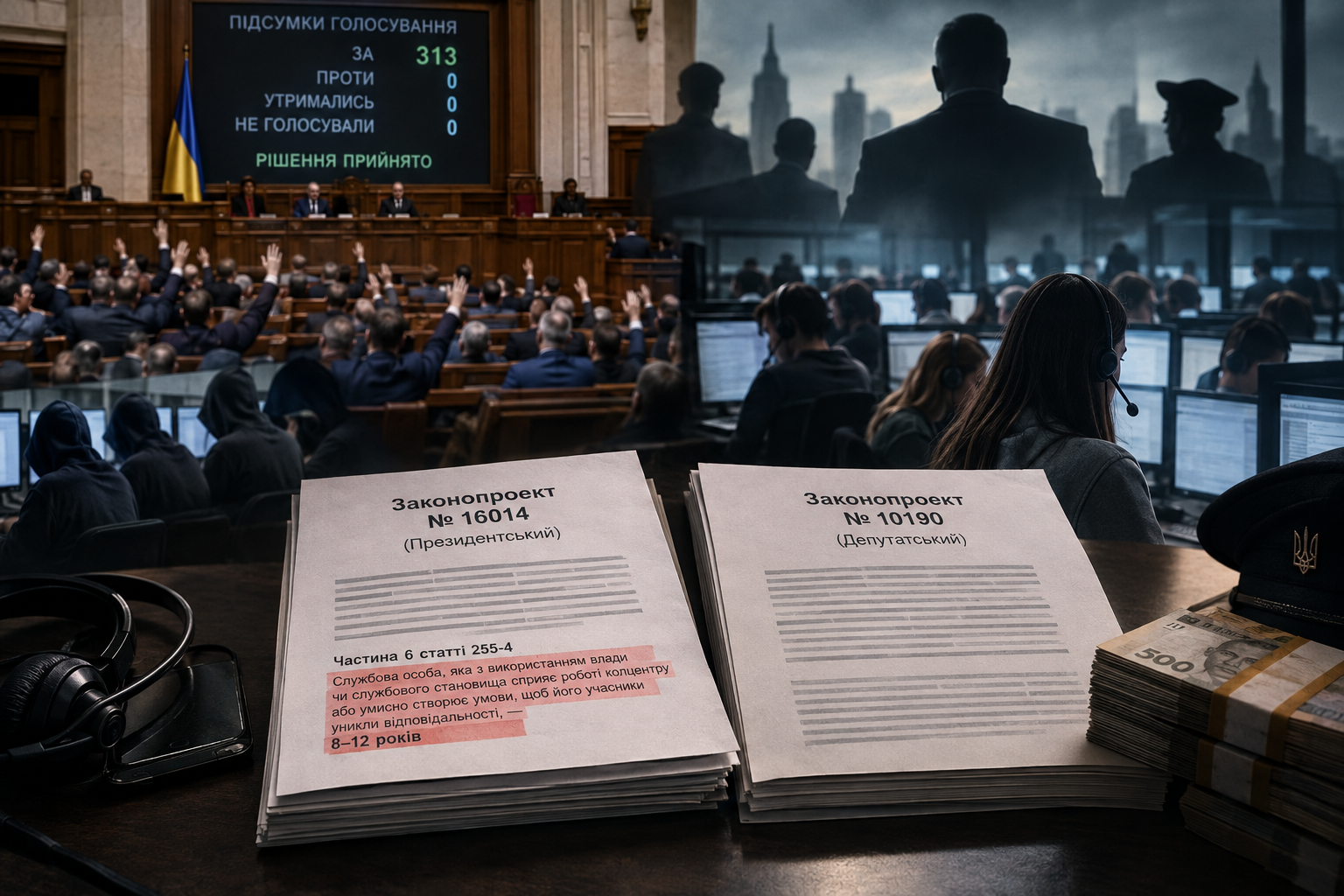
A direct legislative ban on mediation in disputes regarding state procurement is needed. Not a “recommendation,” not a “caveat” – but a clear prohibition. In parallel, mediators should be required to notify law enforcement about identified signs of corruption. Yes, this contradicts the classical understanding of confidentiality. But when it comes to state money – public interest must be higher.
A separate direction is creating a registry of mediation agreements involving state enterprises. It’s not necessary to disclose all details – but the very fact of concluding an agreement and its basic parameters must be public. And finally – protection for whistleblowers. A person who reports corruption should not fear legal consequences for “violating confidentiality.”
Instead of a Conclusion
War is a time when every hryvnia counts. Every jacket that didn’t reach a soldier is a potentially lost life. Every shell that was paid for but not received is an advantage for the enemy.
In such conditions, “peaceful settlement” of theft is not a compromise. It’s betrayal.
Mediation was created to help people negotiate. But when corrupt officials sit at the negotiating table – it helps them avoid accountability.
Transparency is inconvenient. It creates scandals, damages reputations, complicates officials’ lives. But it also saves state money and human lives.
Ukraine cannot afford the luxury of secret agreements where national defense is concerned. Therefore, no mediation in defense procurement.