
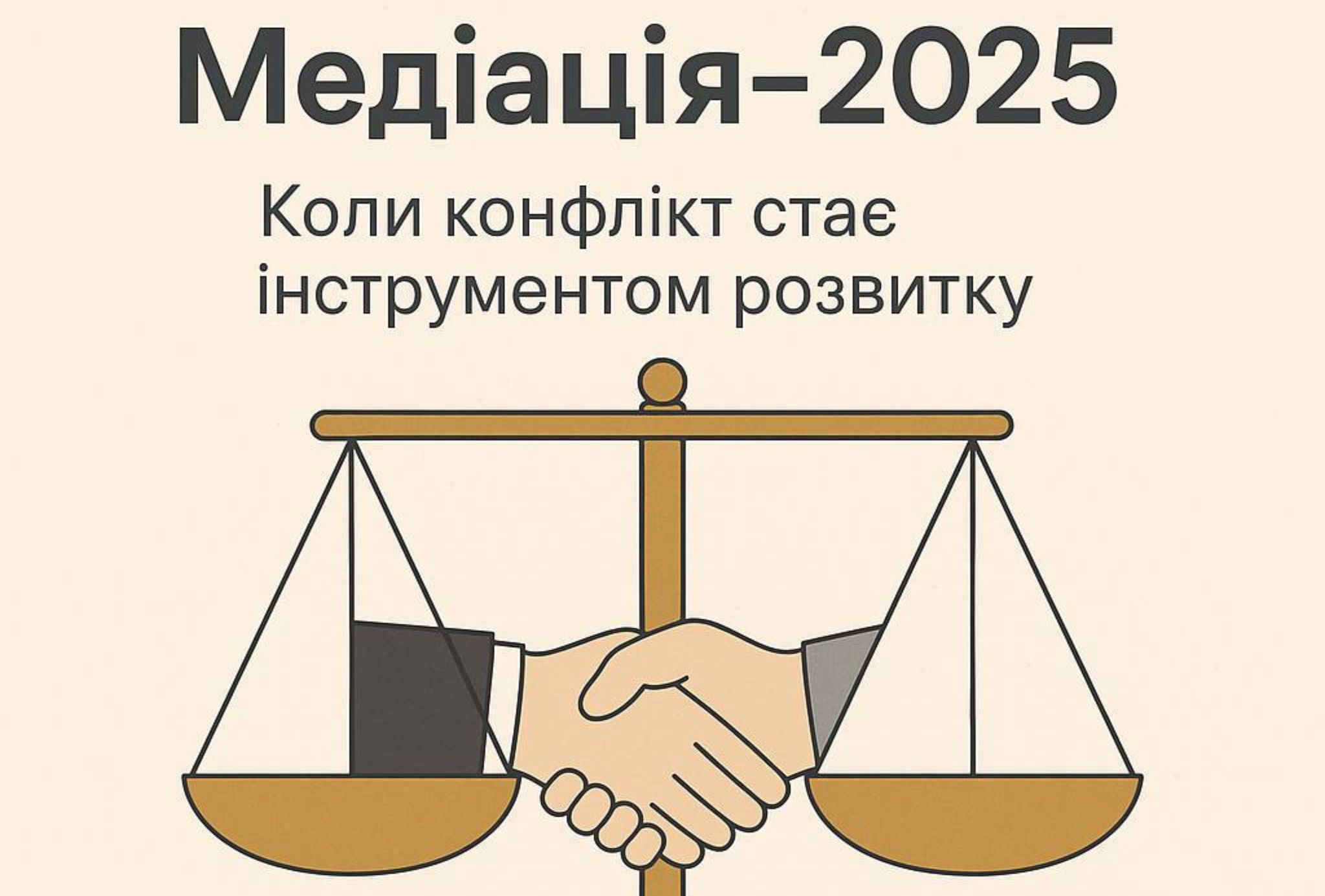
Mediation 2025: When Conflict Becomes a Tool for Development
/ 24 October 2025 14:27
4 min to read
Author: Oleh Horetskyi, Candidate of Legal Sciences, mediator, associate professor
In recent years, mediation in Ukraine has ceased to be something exotic. It is gradually becoming part of the legal culture — a way of resolving conflicts without destroying reputations or relationships. Where previously only a handful of people turned to it, today mediation is increasingly being chosen by businesses, lawyers, and even representatives of government bodies.
The Law on Mediation, which entered into force at the end of 2021, established clear rules of the game. But it is precisely the practice of the past two years that has shown that the key question lies not in the law, but in the maturity of the parties. For mediation works only where there is a genuine desire to reach an agreement and an understanding that strength lies not in confrontation, but in resolution.
Mediation today is a strategy, not a compromise
In 2025, Ukrainian business is confronting new realities. Company relocation, the war, the changing of partners — all of this creates an enormous number of risks and misunderstandings. Often the issue is not a conflict as such, but rather a lack of communication. This is precisely where mediation comes in.
For me, mediation is an opportunity to restore dialogue. It is not a compromise in which both sides “give in,” but a process in which each party obtains an outcome that allows them to move forward. In business this is especially important — because retaining a partner is often more advantageous than winning a court case.
The most common mistakes made by the parties
Experience shows that most people turn to mediation too late, when the parties have already reached a dead end and begun litigating. At that point, even the best mediator can only attempt to “unfreeze” the dialogue.
Another typical mistake is that participants come without the authority to make decisions. Mediation does not work if a person is merely a “representative” who cannot say “yes.”
And of course, there is the matter of confidentiality. In business, information discipline is a question of reputation. What is discussed in mediation should stay there.
When mediation works
It performs best in corporate and partnership conflicts — where what matters is not destroying the business and not turning a dispute into a war.
In tax disputes — as an instrument of dialogue rather than confrontation.
In administrative matters — for the swift resolution of issues between business and the state.
And even in family or inheritance cases, where emotions are often stronger than logic.
How to prepare
Before going into mediation, it is worth honestly asking yourself a few questions: What do I actually want to achieve — money, time, peace of mind, recognition? What concessions am I prepared to make, and what is a matter of principle? And who has the authority to make decisions? Because mediation is not about winning — it is about making a choice.
Courts and mediation: not competitors
In contemporary practice, I frequently observe that courts and mediation work excellently in tandem. One can file a claim so as not to miss the deadlines, while simultaneously negotiating through mediation. If an agreement is reached, it can be formalized as a settlement and approved by the court. This is the healthiest path.
Mediation in Ukraine is gradually transforming from a “soft alternative” into a risk management tool. It makes it possible to preserve resources, restore communication, avoid information attacks, and emerge from a dispute without defeat for either side.
We are learning not only to win, but to reach agreement. And it is precisely in this that the strength of modern law lies.