
The 10th International Forum “Mediation and Law”: about disputes that do not necessarily have to end with a court judgment
/ 3 June 2026 08:43
2 min to read
A court judgment can bring proceedings to a close, but it does not always bring the conflict itself to an end. The parties may receive the court’s answer and still remain in tension: in family relations, business, the workplace, the community, relations with the state, or partnerships. In such situations, the need for tools that can work with the interests and needs behind the dispute becomes especially visible.
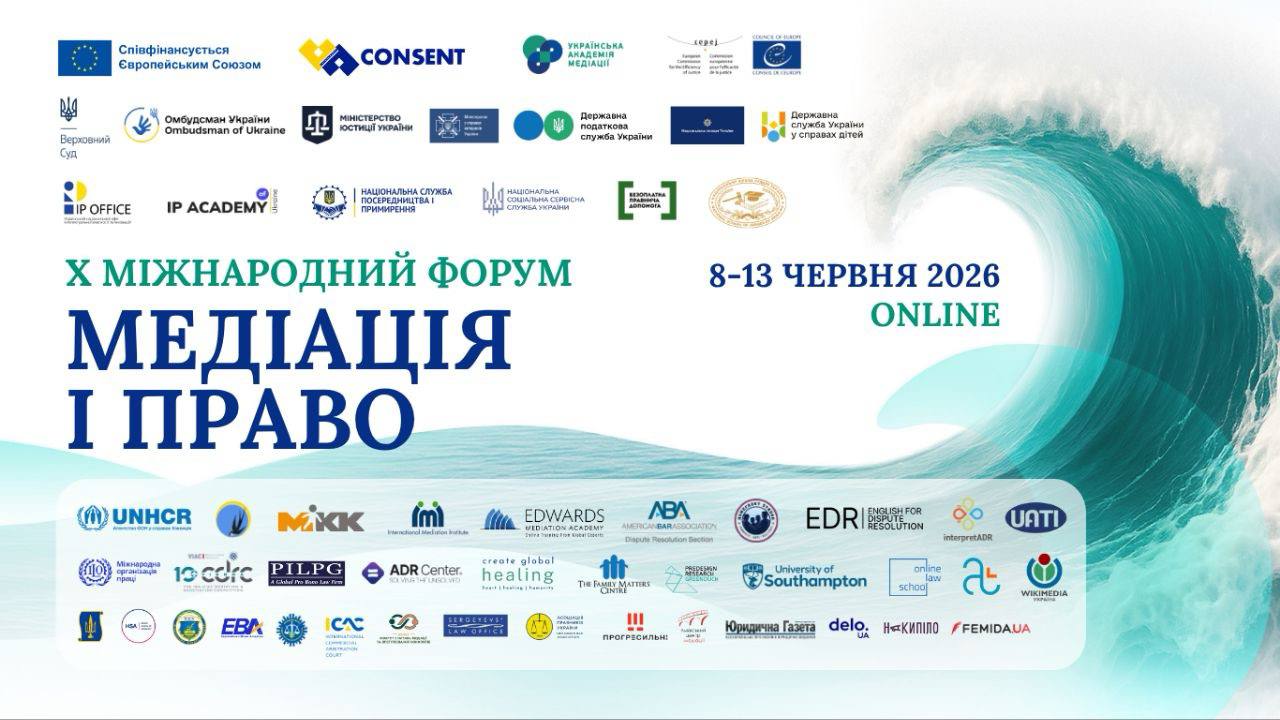
On 8–13 June 2026, the Ukrainian Academy of Mediation will hold the 10th International Forum “Mediation and Law”. The Forum will take place online, in Ukrainian and English, with simultaneous interpretation. This anniversary Forum brings together judges, advocates, lawyers, mediators, insolvency practitioners, representatives of public authorities, human rights defenders, educators, students, business, and civil society.
Mediation can be helpful in situations where the parties are ready to look for a solution but need a safe process, a neutral third party, and an opportunity to hear not only each other’s legal positions, but also their real interests. During the Forum, participants will discuss cooperation between courts and mediators, models of mandatory mediation, European experience, international standards, and Ukrainian practice. Separate discussions will focus on tax, family, labour, commercial, maritime, and other disputes. Mediation in the context of war, social tension, and loss of trust will also be an important topic.
The Forum programme includes panel discussions, expert conversations, and practical sessions with Ukrainian and international professionals. Participants will be able to join the discussions, ask speakers questions, and see how mediation is applied in different fields.
Participation in the Forum is free of charge, subject to prior registration: https://en.mediation.ua/forum/2026
The event is organised by the Ukrainian Academy of Mediation in partnership with the European Commission for the Efficiency of Justice (CEPEJ), with the financial support of the European Union within the EU Project “CONSENT”.
Without an author