
When Profit Is Divided Differently: How Delta Air Lines and Its Pilots Came to Federal Mediation
/ 27 March 2026 13:31
13 min to read
In July 2015, the leadership of Delta Air Lines and the pilots’ union Air Line Pilots Association (ALPA) announced the reaching of a preliminary agreement on a new four-year contract. It seemed that the company, known for its relatively conflict-free labor relations, would once again confirm that reputation. The agreement was signed seven months before the existing contract was due for review — a signal that both sides were constructively minded. But within a matter of weeks, 65% of the pilots voted against it. And what was supposed to be another chapter in the history of successful negotiations turned into a protracted conflict that ultimately brought both parties to federal mediation.
This story is of interest not merely as a labor dispute at a major airline. It serves as an illustration of several fundamental questions that arise in mediation of corporate conflicts: why do people reject agreements that appear reasonable from the outside? How does federal mediation differ from ordinary negotiations? And what happens when both sides have strong arguments — but are unable to reach common ground?
Background: why the pilots rejected an agreement that offered them a 21% pay increase
To understand why the negotiations reached a deadlock, it is necessary to understand the specifics of labor relations in the American aviation industry — and in particular what the word “compensation” meant to Delta pilots.
At the time of the negotiations, Delta pilots were earning some of the highest salaries in the industry. A captain with twelve years of experience flying a wide-body Boeing 777 earned approximately $290,000 per year. A first officer on a smaller Boeing 737-900 with the same seniority received around $160,000. But salary was only part of the overall package — and not even the most important part for many pilots.
Delta had a generous profit-sharing program. The company’s entire workforce — including non-unionized employees — received 10% of the company’s pre-tax profit up to $2.5 billion and 20% of any profit above that threshold. In the record 2014–2015 fiscal year, this amounted to an effective “bonus” of 16.6% of annual salary for pilots. For a captain earning $290,000, that was an additional nearly $50,000 per year — a sum difficult to ignore.
The preliminary agreement rejected by pilots in July 2015 offered an increase in base salary of more than 21% over three years: an immediate increase of 8%, followed by 6% from the first of January of the following year and 3% in each of 2017 and 2018. The agreement also improved compensation for vacation days, training days, and per diem expenses. In light of this, the proposal appeared to be quite competitive.
However, it contained a significant change to the profit-sharing formula. Instead of the existing scheme, the new agreement provided that employees would receive 20% of pre-tax profit only if it exceeded $6 billion, and only 10% of profit below that threshold. In practice, this meant that for pilots to receive the same level of profit-sharing payments as before, Delta would need to nearly double its profits compared to their current level. With the profit of $2 to 3 billion that the company was demonstrating at the time, pilots would lose a significant portion of their additional payments.
For many pilots, the math was discouraging: the increase in base salary did not compensate for the potential losses resulting from the change to the profit-sharing scheme. And they voted “no” — by a convincing margin of 65 to 35.
Industry context: why Delta pilots felt shortchanged
The rejection of the agreement took place against the backdrop of substantial changes in the labor market of the American aviation industry — and this context is critically important for understanding the union’s position in the subsequent negotiations and in mediation.
In early 2015, pilots at American Airlines ratified a new contract with an immediate increase in base salary averaging 23% and further annual increases of 3% over five years. The base salaries of American Airlines pilots came to be 8 to 15% higher than those at Delta. Somewhat earlier, United Continental pilots had agreed to a contract extension that raised their base salary to the highest level in the industry. On certain aircraft types, base pay at United and American was comparable, and on some types United pilots earned up to 5% more.
Thus, among the three major American carriers — American, United, and Delta — Delta pilots found themselves at the bottom in terms of base salary. The fact that Delta remained the most profitable of the three companies only sharpened the sense of injustice.
The ALPA union responded accordingly. In December 2015, following the resignation of the previous MEC leadership (which had supported the rejected agreement), the new leadership headed by Captain John Malone put forward a counter-proposal: an immediate increase of 22%, followed by two annual increases of 7% each. By 2018, the total increase in base salary was to amount to approximately 40%. This proposal would not merely bring Delta pilots level with their competitors — it would put them 15% ahead of United pilots by 2018.
Delta’s management rejected this proposal. Analysts calculated that implementing the union’s demands would cost the company approximately $750 million annually on the pilots’ contract alone. Given that Delta had other employees — who earned considerably less than pilots but could also reasonably claim pay increases — the total cost of similar concessions across the entire company would have exceeded $2 billion per year.
Delta could afford such costs at its then-current level of profitability and with low fuel prices. But fuel prices are unpredictable, and the company did not want to take on commitments that could prove catastrophic in the event of changing market conditions.
Federal mediation: what it is and why it differs from ordinary negotiations
On March 31, 2016, Delta and ALPA jointly submitted an application to the United States National Mediation Board (NMB) — the federal body that regulates labor relations in the aviation and railway industries under the Railway Labor Act.
This step was not a voluntary gesture of goodwill but a requirement of the previous contract. But the very fact that both sides jointly turned to a mediator was an important signal: both parties formally acknowledged that they were unable to reach an agreement on their own.
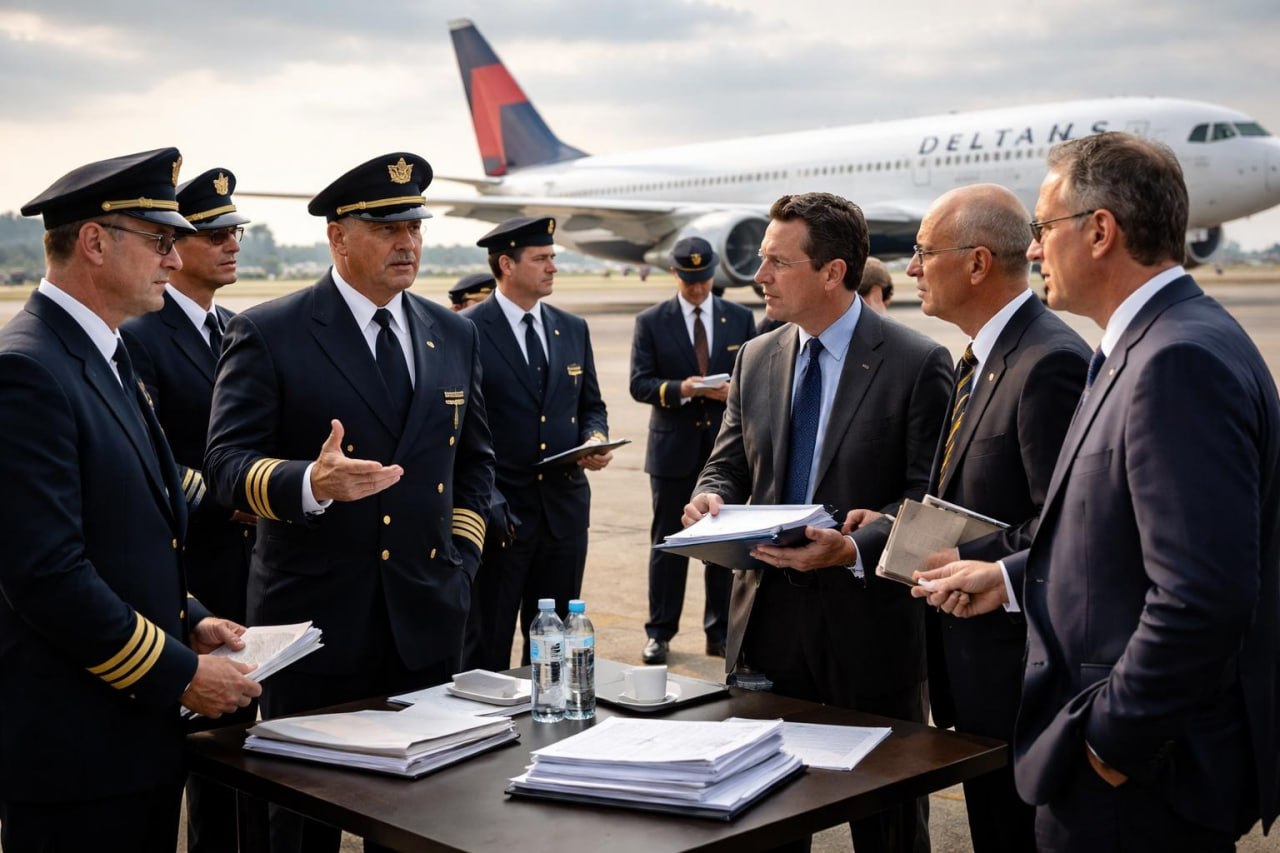
Federal mediation in the aviation industry differs substantially from classical corporate mediation, in which the mediator is a neutral facilitator without powers of authority. The NMB has significantly broader instruments of influence over the process. The federal mediator assumes control of the negotiating calendar: he determines when and how frequently the parties meet, and may insist on the continuation of negotiations even when one side wishes to take a break. The process may last for months or even years — the NMB is not obligated to rush.
But the most fundamental feature of federal mediation in the aviation industry relates to the strike. Under the Railway Labor Act, aviation employees do not have the right to strike until the mediator officially “releases” them from the mediation process — that is, declares the negotiations definitively broken down. This means that for as long as federal mediation is ongoing, Delta pilots are effectively deprived of their main bargaining chip. They may engage in informational picketing — as occurred in June 2016, when pilots picketed Delta hubs across the country — but they cannot declare a strike.
This asymmetry is an important structural element of federal mediation in the aviation industry. On one hand, it protects passengers and the economy from damaging strikes in critical infrastructure. On the other hand, it weakens the union’s negotiating position and may theoretically incline the mediator toward more moderate recommendations. A more detailed examination of mediation practices in similarly asymmetric conflicts can be found in my book “Mediation: Ukrainian Experience and European Choice,” which i available in electronic format.
The dynamics of the conflict: why both sides were right — and why this made agreement more difficult
One of the paradoxes of the Delta case was that both sides had entirely well-founded positions. And it was precisely this that made finding a compromise especially difficult.
Delta pilots did indeed earn less than their counterparts at American Airlines and United Continental in terms of base rates. They did indeed make a significant contribution to the company’s record profitability — in the first quarter of 2016, Delta posted a pre-tax profit of $1.56 billion, which was nearly three times the record first quarter of the previous year. They did indeed accept pay cuts during the company’s bankruptcy in the 2000s and were now counting on the restoration of fair compensation.
Delta, for its part, had no less compelling arguments. The company was already offering a substantial salary increase. It was retaining the profit-sharing program, which American Airlines did not have at all. The union’s demands for a 40% increase over three years would have been the highest in the industry — and would not merely have restored parity with competitors but would have put Delta pilots 15% ahead. And finally, the company had a responsibility to all of its employees, not only to the pilots.
It is precisely this situation — where both sides have compelling arguments but their positions are incompatible — that is a classic scenario for mediation. In such cases, the mediator does not act as a judge determining who is right, but as a facilitator helping the parties to see where their interests intersect and to find a solution acceptable to both.
Captain John Malone, the chair of the Delta MEC, articulated the union’s position as follows: “All other stakeholders — management, other employees, investors — have already received their reward. It is time for the pilots.” This rhetoric appealed to a sense of fairness and was readily understood by a broad audience. But it also reflected a classic negotiating trap: positional thinking in which the victory of one side automatically means the defeat of the other.
At the same time, the informational picketing in June 2016, in which Delta pilots took to the hubs across the country with placards, had its own logic: even without the right to strike, the union sought to publicly signal its discontent and demonstrate the solidarity of its members. This was less a matter of pressure on the negotiations than a signal directed at public opinion and the company’s shareholders.
The role of the mediator: between facilitation and market reality
When the federal mediator began his work, he faced a task typical of labor disputes in profitable companies: to persuade the union to lower its demands to a realistic level, and the company to raise its offer to a level that the union could sell to its members.
Analysts noted that in this case the union risked hearing an unpleasant truth from the mediator. Delta’s initial proposal — an increase of more than 21% — was already in principle consistent with industry standards, when the profit-sharing program was taken into account. The union’s counter-proposal of a 40% increase and a position 15% ahead of United Continental appeared disproportionate against the backdrop of actual market conditions.
But the mediator could not simply tell the union “your demands are excessive” and leave it at that. Effective mediation involves working with both parties: understanding the real interests behind the declared positions, seeking creative solutions that could satisfy those interests without a direct collision of positions.
In the Delta case, the key question was not only about the figures but about the structure of compensation. Pilots valued profit-sharing — not only as a financial instrument but as a symbol of their being co-participants in the company’s success. This is precisely why the altered profit-sharing formula in the initial agreement was felt so painfully: it did not merely reduce potential payments but symbolically excluded pilots from the ranks of the main beneficiaries of Delta’s success.
The mediator’s task in such a situation was to help the parties separate the symbolic dimension from the financial one and find a formula that would satisfy both. This might have meant retaining the profit-sharing principle in a more generous form in exchange for a more moderate base salary increase. Or tying increases to specific financial indicators of the company, which would give pilots more in good years and less in bad ones.
Lessons for mediation practice
The Delta case is instructive from several standpoints for those who study or practice mediation in labor and corporate conflicts.
First, it demonstrates the importance of understanding that people reject agreements not only for rational reasons. The initial 2015 agreement was rejected not because pilots calculated that a 21% increase would not cover inflation or the market gap. It was rejected largely because of the psychological sense that the profit-sharing formula represented a step backward — a signal of their diminished role in the company. A mediator who does not understand this psychological dimension risks proposing financially rational but practically unworkable solutions.
Second, the case illustrates the role of external context in negotiations. The contracts at American Airlines and United Continental, signed shortly before the start of mediation, became a powerful argument and reference point for the Delta union. The mediator could not ignore this context — but neither could he simply apply the industry standard mechanically to a company with a unique compensation structure.
Third, the Delta case is a good example of how the structural features of a particular mediation procedure — specifically the prohibition on strikes during federal mediation — affect the balance of power and the strategies of the parties. A union deprived of the right to strike cannot afford to drag out negotiations indefinitely in the expectation of wearing down its opponent. The company, knowing this, may be less inclined to make concessions. An effective mediator must take these structural factors into account and work with them, rather than pretending they do not exist.
Conclusions
The conflict between Delta Air Lines and ALPA pilots is a classic example of how a labor dispute in a profitable company can reach an impasse even when both sides formally want to resolve it. The pilots did not want to strike — they wanted fair compensation. The company did not want a protracted conflict — it wanted predictable costs and operational stability. But the declared positions proved so far apart that without external intervention an agreement was unattainable.
Federal mediation in such cases is not a last resort but a natural next step in a structured process for resolving labor conflicts. It provides the parties with a neutral platform, an external assessment of the realism of their positions, and, where necessary, pressure on both participants to take steps toward each other.
The key lesson to be drawn from this case is universal and extends far beyond the aviation industry: an agreement that people perceive as unfair — even if it is financially advantageous — is not a stable agreement. A mediator who understands this difference between objective benefit and the subjective sense of fairness has a significantly greater chance of bringing the parties to an outcome that both will support.