
When the Gates Close: Six Months of Lockout, 36 Sessions of Mediation, and the High Cost of Silence
/ 10 April 2026 16:46
13 min to read
In the United States, labor conflicts in critical infrastructure such as gas networks are never merely corporate disputes. They are matters of life and death for hundreds of thousands of families, the stability of entire regions, public trust in major energy companies, and ultimately public safety. The 2018–2019 case of National Grid versus the United Steelworkers (USW) in Massachusetts became a textbook example of how far escalation can go when the parties stop hearing each other — and of how mediation can turn a situation around even after months of entrenched confrontation.
More than 1,250 experienced gas workers were locked out for nearly six months. The company replaced them with temporary contractors, which immediately triggered a wave of complaints about errors and safety risks. Hundreds of families found themselves without stable income, without health insurance, with deferred medical treatment and mounting psychological pressure. Politicians, regulators, local communities, and even US senators became actively involved. And the conflict ended not in court, not after a strike, not after anyone’s capitulation — but with a detailed collective agreement, reached after 36 sessions of federal mediation.
This is the story of how two powerful parties — a global corporation and a strong union — reached a point of rupture, and then found a common language. And of the extraordinary price paid for every delay, every day without compromise, and every decision to deploy the “nuclear option” in labor relations.
The Night Everything Stopped
At five o’clock in the morning on June 25, 2018 — by some accounts, late in the night of June 24 — Marcy Reed, president of National Grid in Massachusetts, gave the order to lock the gates at all of the company’s facilities in the region. The night before had been exhausting to the limit: negotiations that had dragged on for months had reached a dead end. The phones had not stopped — at midnight, at one, at two, at three in the morning. Every hour brought new arguments but no movement toward a resolution.
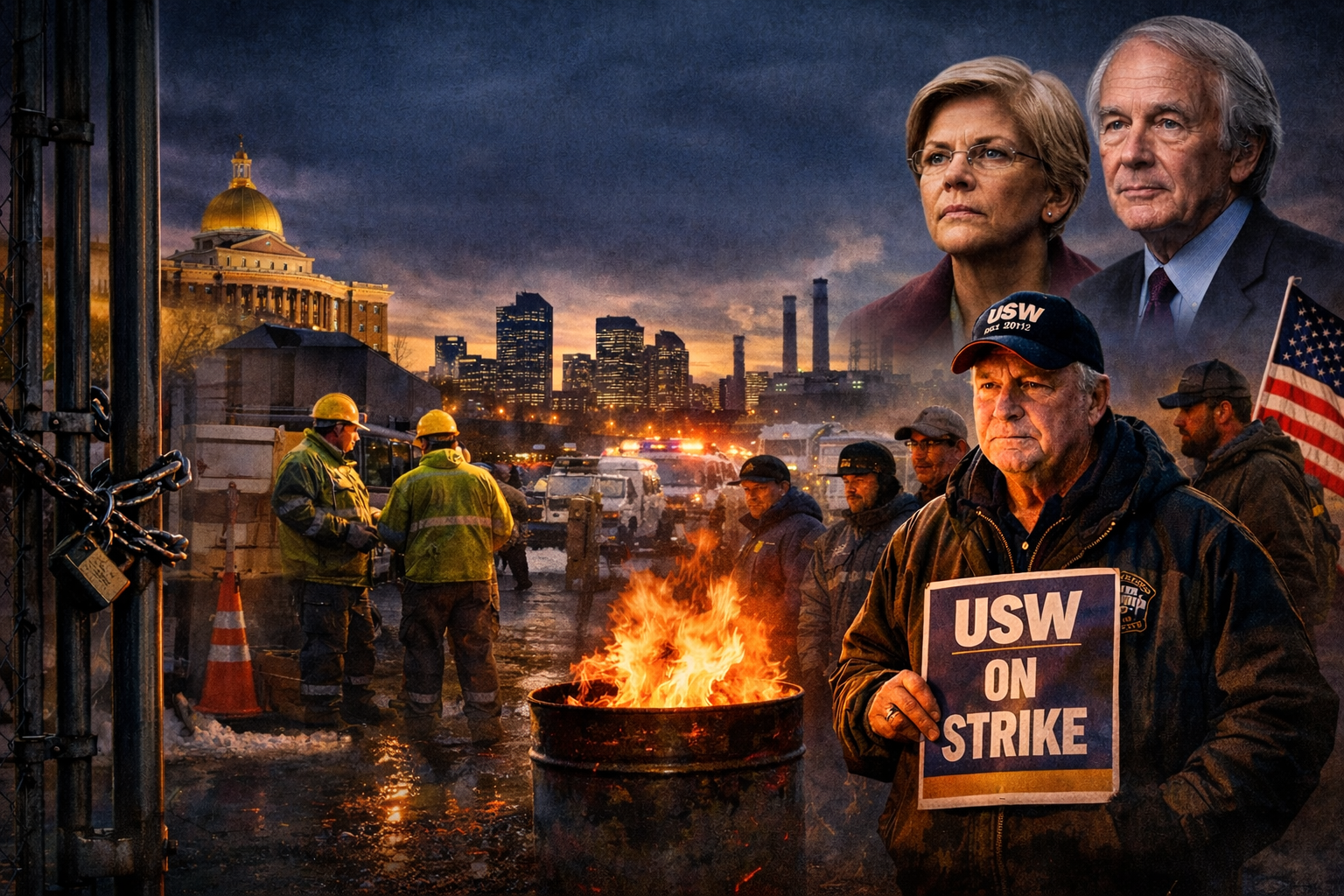
When it became clear there would be no compromise that night, National Grid — a British energy giant that operates gas and electricity networks in England and the northeastern United States — declared a lockout of 1,250 workers in eastern Massachusetts. At dawn, gas technicians, pipe fitters, and emergency response specialists arrived at the familiar gates — people who had worked at the company for decades, who knew every pipe, every pressure regulator, and every quirk of the networks serving 85 cities and towns in the region. The gates were locked. In their place, temporary contractors and managers took up positions on the sites.
This was the beginning of one of the most prolonged and consequential labor conflicts in recent American history. It lasted nearly six months, cost both sides millions of dollars, damaged dozens of careers, left deep scars in families, and put the safety of gas supply for 700,000 customers at risk. All of it over a dispute that many initially regarded as “technical.”
Who Was Fighting, and for What
National Grid is not a local utility. It is a global corporation with multibillion-dollar revenues, which positions itself as a modern market player willing to invest in infrastructure — while also facing the need to control costs. In Massachusetts, the company bore full responsibility for the safe gas supply of approximately 700,000 households and businesses.
The United Steelworkers (USW) is one of the most influential industrial unions in North America, with more than 850,000 members. Within the USW structure, “locals” are the grassroots chapters that operate at the level of a specific workplace or region. Locals 12003 and 12012–04 were the chapters representing the interests of 1,250 National Grid workers — gas technicians and network maintenance specialists in 85 cities and towns of eastern Massachusetts, some of whom had started their careers under National Grid’s predecessor, Boston Gas.
The dispute formally centered on “technical” questions: pension plans, health insurance, and conditions for new hires. National Grid proposed replacing traditional defined-benefit pensions for incoming workers with a savings plan in which all investment risk falls on the employee. The company also wanted to shift a portion of health insurance costs directly to employees and to increase the use of contractors.
The union saw in this a dangerous move toward a “two-tier” system that would devalue the experience and knowledge of veterans. John Buonopane, president of Local 12012, was direct and passionate: the company earns billions of dollars, and its workers — who risk their lives every day repairing dangerous gas networks — deserve to keep the guarantees they had defended over decades. The union refused to put the proposed package to a membership vote, regarding it as unacceptable and destructive to the future of the profession.
Negotiations had continued for months, with several contract extensions but no real breakthrough. Rather than continuing the dialogue or allowing workers to express their view through a vote, National Grid chose the radical step of a lockout. In American labor relations, this is considered the “nuclear option”: the employer effectively bars workers from their jobs in an attempt to exert economic pressure on the union and force concessions.
Communities Placed at Risk
While experienced gas workers stood on picket lines, National Grid aggressively hired contractors — often less qualified and less familiar with the local networks. The union filed more than 200 complaints with the Massachusetts Department of Public Utilities (DPU).
The most vivid and most dangerous incident occurred on October 8, 2018, in Woburn. A temporary worker accidentally over-pressurized a gas network serving approximately 300 homes. Veteran gas workers who had been monitoring the situation were forced to go door to door, manually shutting off supply to prevent a potential catastrophe. The incident unfolded in the immediate aftermath of the devastating Merrimack Valley gas pipeline explosions of September 2018, in which people died and dozens of homes were destroyed.
The DPU imposed a moratorium on all non-emergency work by National Grid. The cities of Arlington, Cambridge, Somerville, and others barred contractors from their streets for routine operations. More than 50 complaints concerned specific errors: damaged pipes, faulty welds, ignorance of the characteristics of aging networks. Governor Charlie Baker, House Speaker Robert DeLeo, and Senators Elizabeth Warren and Ed Markey publicly demanded explanations and called on the company to end the lockout. Many stated plainly: experienced workers are the guarantee of safety, and their absence poses a real threat to communities.
The Role of Federal Mediators: When the State Becomes a Bridge
The United States has operated an independent Federal Mediation and Conciliation Service (FMCS) since 1947 — an agency created specifically to prevent and resolve labor conflicts, without the power of compulsion. Its strength lies in its neutrality, its professional structure, and its experience across thousands of comparable cases.
Commissioner Martin Callaghan of the FMCS Boston office became involved in the case as early as April 2018 — well before the lockout. He began mediating the negotiations in June. Together with colleagues Barbara Owens and Todd Austin, they accompanied the process through to its conclusion. In total, 36 sessions of collective bargaining mediation took place. Thirty-six — months of intensive work, including continuous meetings through Christmas and the New Year, when most people celebrate with their families.
Mediation of this kind is far more than one long meeting in a conference room. It is dozens of hours of joint sessions and as many again in the format of “caucuses” — private conversations between the mediator and each side separately. In caucus, National Grid managers could speak openly about financial constraints, investment plans, and the need for operational flexibility. USW representatives could speak about the real fears of their members, about how the lockout was affecting families, about the “red lines” that are never stated publicly. The mediator does not relay words literally; he uses them to find the hidden space for compromise.
In this case, the distrust was profound. The union regarded the lockout as an instrument of crude pressure; the company viewed it as a necessary step toward structural modernization for the twenty-first century. Public statements only deepened the confrontation — the company spoke of “modernization,” the union of “greed from a foreign corporation.” FMCS helped to gradually shift the conversation from hard positions to underlying interests: the company needed operational flexibility and cost control; the union needed protection for experienced workers, decent working conditions, and safety guarantees for the communities they served.
A closer look at how a mediator works with stated positions and the interests behind them — including the specific techniques used to bridge the distance between them — can be found in Mediation: Ukrainian Experience and European Choice, available on Apple Books.
The Winter Holidays as a Powerful Deadline
One of the most significant tactical elements of the process was the decision to hold continuous sessions through Christmas and the New Year. This was a deliberate strategy on the part of the mediators. The holidays are not merely days off — they are a powerful psychological deadline. No one wants to enter a new year locked in a protracted war. For the company: mounting reputational damage, pressure from customers, regulators, and politicians. For the union: 1,250 families facing winter without full income or health coverage. For everyone: accumulated exhaustion after nearly six months of confrontation.
The mediators kept both parties at the table precisely when most others would have long since postponed negotiations “until after the holidays.” That persistence paid off. On January 2, 2019, the parties reached a tentative agreement. On January 7, USW members voted to ratify it by a convincing margin.
What the Final Agreement Delivered
The contract was concluded for five and a half years, running through the end of 2024. It provided substantial wage increases — averaging approximately 4% annually — along with the preservation and in some respects enhancement of pension and health guarantees for current workers, and the creation of new positions linked to community safety. The company secured the transition to a 401(k) plan for new hires. But the union protected full coverage for existing workers and won a series of important concessions on working conditions and safety.
After signing, Marcy Reed stated: “We recognize that our labor dispute was hard on our employees, customers and communities. We look forward to welcoming our union workers back.”
USW representatives emphasized that the agreement delivered substantial wage increases, key protections for workers, and provisions that genuinely enhance public safety.
FMCS Acting Director Rich Giacolone summarized: “It’s been a long six months… Getting back to work is good for the employees, good for the company, and good for the customers who depend on the system.”
Senators Warren and Markey, along with many local officials, welcomed the end of the lockout, noting that tactics of this kind cause real harm to families and communities.
Four Lessons That Reach Far Beyond Massachusetts
First: mediation is most effective as a preventive instrument. FMCS became involved as early as April — and even that proved insufficient to prevent the lockout. The earlier a structured, professional process begins, the lower the probability of a crisis that then costs everyone enormously.
Second: the length of the process is not always a sign of failure. Thirty-six sessions sounds like exhaustion and wasted time. In reality, it is testimony to the stamina of the parties and the high skill of the mediators. As long as people continue to come to the negotiating table, the possibility of an agreement survives.
Third: public narratives and real interests are often entirely different things. The company spoke publicly of “necessary structural reforms”; the union spoke of “abuse of American workers.” The mediators were not working with newspaper headlines but with underlying needs: operational flexibility and cost control for the company; dignity, protection of expertise, and community safety for the workers.
Fourth: external context and timing are powerful allies of the mediator. Fatigue after six months, the winter holidays as a natural deadline, public pressure, political intervention, risks to public safety — the mediators skillfully used all of these to keep both sides in the process and help them see the mutual benefit of an agreement.
What This Conflict Actually Cost
It is worth counting the real price honestly. 1,250 workers without full wages and health coverage for nearly six months. Enormous company expenditures on hiring and training contractors who often worked less effectively. Reputational damage: withering criticism from senators, local politicians, and civic organizations. More than 200 safety complaints, a DPU moratorium, and political hearings. Legal bills, operational disruptions, lost tax revenue for the state amounting to millions of dollars. Psychological trauma for hundreds of families, deferred medical treatment, applications for social assistance. International union solidarity from dozens of countries, marches, and protests.
And now the reverse question: what would mediation begun six months earlier have cost? Several hundred hours of work from three experienced FMCS commissioners, plus a few additional sessions in the spring and summer of 2018. And in all probability, an agreement reached without David Monahan receiving a cancer diagnosis in the middle of the lockout, without the Woburn incident, without children’s suffering, and without the loss of trust that is so hard to restore.
Mediation is not a luxury or an “expensive service.” It is a cost-effective, humane, and rational alternative to a costly, painful, and destructive conflict.
After the Agreement: Scars That Do Not Vanish Overnight
Joe Chirillo, president of Local 12003, said after the agreement was signed: “Some people will never forget this. When your child is sick and they cut off your health insurance — that’s not something you forget.”
He is right. The legal and financial conflict was resolved. Workers returned to their jobs — planned for the week of January 20, 2019. But human relationships are an entirely different matter. Years of shared work, mutual trust, and professional solidarity are destroyed in months of escalation. Restoration requires time, daily effort, and a new culture of dialogue.
This is why experienced mediators always emphasize: an agreement is not the end of the story but only an important checkpoint. The real work begins afterward — helping the parties learn to hear each other, to prevent new crises, and to build functional, respectful relationships. So that the gates are never locked again.
The National Grid and USW case entered the canon of mediation and labor law not because the process was quick or easy. It entered because mediation worked at all. After six months of confrontation. After hundreds of public accusations. After real pain that “some will never forget.”
That is the most powerful demonstration of what a well-organized mediation process can do: it can reverse even the deepest conflict dynamic and restore the possibility of dialogue at a moment when it seems the point of no return was passed long ago.