
CEOs at the Negotiating Table: How Apple and Samsung Avoided Total War
/ 27 February 2026 20:13
12 min to read
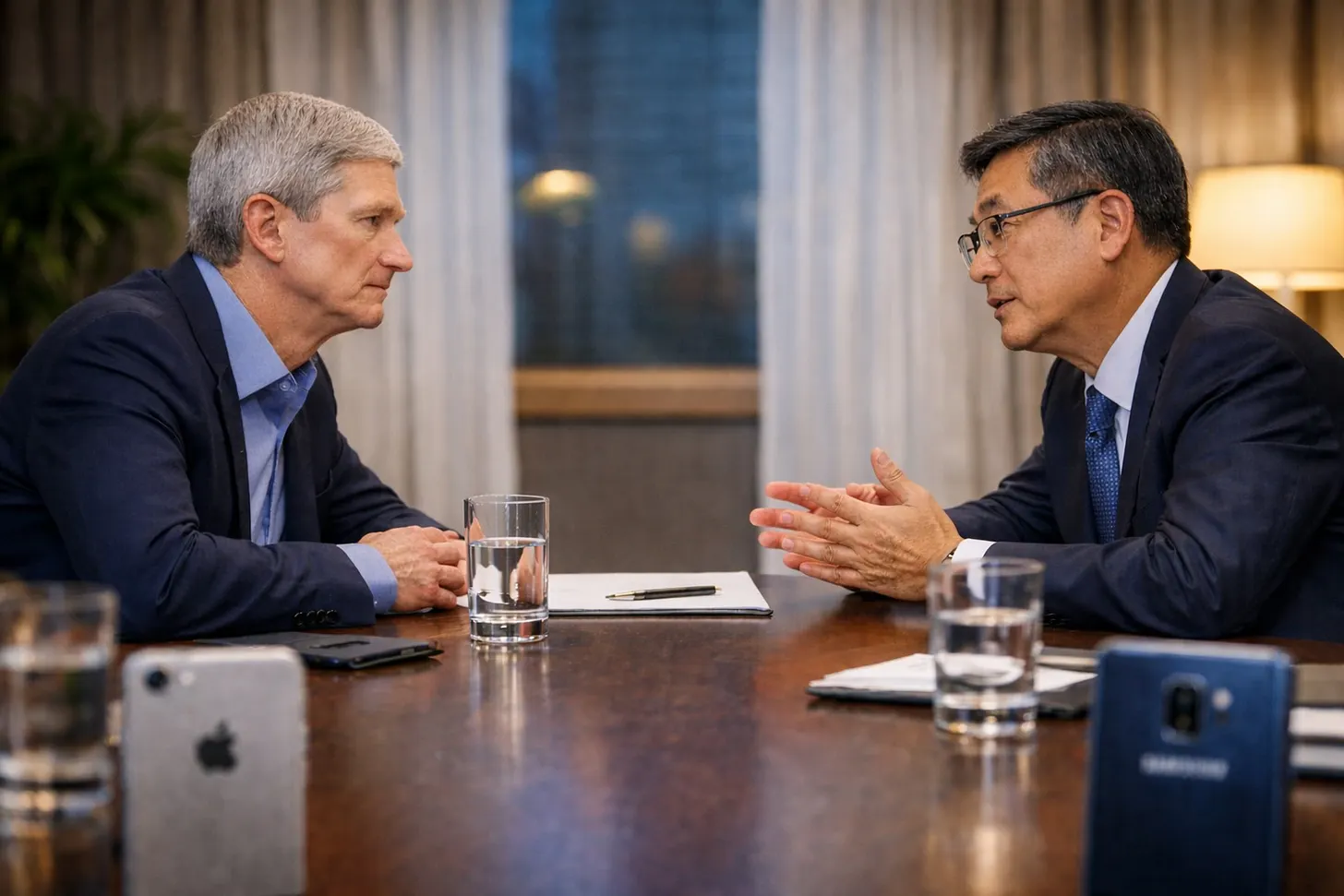
In May 2012, something unusual happened in the corporate world: two of the most influential executives in the technology industry — Tim Cook of Apple and Gee-Sung Choi of Samsung — sat down at the same table with a federal judge. Not in a courtroom, not in a clash of lawyers, but as part of a mediation process aimed at finding a peaceful resolution to a patent conflict that had spread across courts on four continents. This meeting became one of the most high-profile attempts at corporate mediation in modern legal practice — and at the same time, a vivid lesson in when and why even the best negotiation format cannot guarantee success.
The history of the Apple–Samsung confrontation is not merely a legal chronicle. It is a mirror reflecting all the key challenges of mediation in complex commercial disputes: the psychological hardening of positions, the paradox of competitors’ mutual dependence, and the question of when negotiation is still possible — and when it is already too late. This is precisely why this case is studied in detail in mediation and negotiation curricula, both in law schools and business education programs.
Patent Wars in the Tech Industry: Why They Are Never-Ending
To understand the scale of the conflict between Apple and Samsung, one must appreciate the specific nature of patent wars in the technology sector. Unlike disputes over real estate or contract law, where the object of the dispute is clearly defined, patent conflicts in technology have a natural tendency toward limitless expansion.
Every smartphone contains thousands of patented solutions — from the shape of its casing to the screen unlock algorithm. When one company files a suit over several patents, the competitor’s response almost automatically includes counterclaims. This creates a “patent thicket” — an interwoven network of claims that is extremely difficult to untangle in court and even harder to resolve at the negotiating table.
In April 2011, Apple filed suit against Samsung in a California federal court, accusing the Korean manufacturer of copying the appearance and functionality of the iPhone in its Galaxy lineup. The claims covered three utility patents and four design patents. Samsung responded with countersuits — and not only in the United States. Legal fronts opened in Korea, Japan, Australia, the United Kingdom, Germany, France, the Netherlands, and Italy.
Patent disputes in the technology industry share another defining characteristic: they rarely end with a clear victory for either side. Instead, they exhaust the resources of both companies, destabilize the market, and create legal uncertainty for the entire industry. It is no surprise that Judge Lucy Koh — who presided over the Apple v. Samsung cases in California — told the parties frankly: “You should not laugh at me, but even in my own chambers they laugh when I mention a peaceful settlement.”
And yet Judge Koh insisted on mediation. That decision — despite the skepticism — opened one of the most instructive precedents in the history of corporate negotiation.
Mediation Involving a Judge: A Rare Format and Its Advantages
When people talk about mediation, most imagine a neutral intermediary — a conflict resolution specialist who helps parties find a compromise outside of court. This is the most common, most classical format: an independent mediator chosen by the parties themselves, conducting the process in confidence, without procedural constraints and without the pressure of the judicial system. This approach is most often recommended by corporate conflict resolution specialists: it gives the parties maximum flexibility, allows interests to be discussed openly, and enables solutions that go far beyond what a court can award.
In the Apple v. Samsung case, however, the first stage used a different, rarer format — judicial mediation. This meant that the federal judge herself initiated and facilitated negotiations between the parties, proposing a peaceful settlement before the case reached a full trial. This approach has obvious advantages: the judge’s authority sends the parties a clear signal that the court favors a non-judicial resolution; a judge who has immersed herself in the details of the case can give both sides a more candid picture of their chances than their own lawyers would; and finally, an agreement at this stage can save the parties millions of dollars that have not yet been spent on a full trial.
Judge Koh took an unconventional approach: she required that the CEO of each company personally participate in negotiations — without outside lawyers, with only three or four in-house counsel from each side. This was a decision of principle. Outside attorneys — financially incentivized to prolong the case — often become unwitting saboteurs of negotiation. Removing them from the process allowed direct conversation with the people who actually make decisions.
Later, when judicial mediation reached an impasse, the companies turned to the classical format: before the second trial in 2014, they agreed to mediation with an independent intermediary — someone with experience in high-profile corporate cases who had no connection to the judicial system. This transition from judicial to classical mediation is a telling detail: a neutral mediator without a robe and without procedural powers is sometimes more effective precisely because they are not associated with pressure and compulsion.
Why This Format Is Rare and Valuable
CEO participation in negotiations is an uncommon practice, regardless of who conducts the mediation — a judge or an independent intermediary. Chief executives typically delegate conflicts to legal departments and do not wish to be publicly associated with concessions. But direct dialogue between organizational leaders can unlock opportunities unavailable to lawyers: discussion of business interests rather than merely legal positions; unconventional solutions that fall outside legal categories; preservation of reputation and relationships that lawyers often do not consider.
CEO mediation — regardless of who sits in the mediator’s seat — is in essence the closest real-world analog of what negotiation theory calls “principled negotiation,” or interest-based negotiation. When company leaders sit at the table, the question shifts from “what are you claiming legally?” to “what does your business actually need?” These answers often open a path to agreement.
It is precisely these mechanisms — the escalation of commitment, psychological readiness for compromise, working with interests rather than positions — that are analyzed in detail in my book Mediation: Ukrainian Experience and European Choice. Drawing on real cases from international corporate disputes, the author shows how a mediator recognizes the moment when the parties are for the first time genuinely ready for an agreement — and what must be done to ensure that moment is not missed. The book will be of value to practicing mediators and lawyers, as well as to executives who must resolve conflicts before they become seven-year legal sagas.
What the CEO Meeting Actually Achieved: The Details of a Partial Agreement
The two-day meeting in May 2012 between Tim Cook and Gee-Sung Choi ended without an agreement. But that does not mean the negotiations were fruitless — they gave both sides a better understanding of each other’s positions and underscored the real cost of continuing the conflict.
The litigation proceeded. In August 2012, the jury awarded Apple more than one billion dollars in damages — a record sum in patent disputes at the time. Samsung was found to have willfully infringed Apple’s design patents covering the “bounce-back” scrolling effect, on-screen navigation, the “tap to zoom” feature, as well as the design of the Home button, rounded corners, and icons.
But this Apple victory proved to be merely the beginning of a new cycle: appeals, retrials, reductions in damages, then increases again. The case passed through the Court of Appeals and the U.S. Supreme Court, and after many years of litigation the companies ultimately reached a private settlement in June 2018 on undisclosed terms. By that point, Apple had received between $290 million and $539 million in various rulings, depending on the stage of proceedings.
A second mediation attempt took place in 2013–2014, ahead of the second trial. Judge Koh again insisted on negotiations. This time Apple’s and Samsung’s CEOs (by now Samsung’s new head was Kwon Oh-hyun) met and again failed to reach agreement. In February 2014 the parties agreed to mediation with an independent intermediary experienced in high-profile cases — again without outside lawyers. This mediation was part of the preparation for the second trial, in which Apple sought another $2 billion and was awarded $119.6 million.
Partial agreements are the reality of complex corporate disputes. Sometimes companies reach agreement in some jurisdictions but not others. Sometimes they resolve some patent claims while leaving others open. These incremental achievements, accumulating over time, gradually narrowed the battlefield — until the final settlement in 2018.
Preserving Partnership Amid Competition: The Apple–Samsung Paradox
Perhaps the most striking aspect of the entire conflict is the fact that Samsung was — and remains — one of Apple’s key component suppliers. While the lawyers of the two companies exchanged accusations in courts on multiple continents simultaneously, engineers and managers of those same companies were signing contracts for the supply of processors, screens, and memory chips.
This paradox — “coopetition” (simultaneous competition and cooperation) — is characteristic of the modern technology industry. Apple needed Samsung as a manufacturer. Samsung needed Apple as a customer. Neither side could afford a complete severing of relations. And this, paradoxically, was both the reason for the conflict’s duration and, ultimately, the foundation for its resolution.
It is telling that this very aspect — the commercial interdependence of the parties — is one of the strongest arguments for involving an independent mediator at the earliest stages of a conflict. An experienced mediator can see and articulate what the parties in the heat of battle are unwilling to acknowledge aloud: that their long-term interests require coexistence, not mutual destruction. A judge in the role of mediator is constrained by procedural boundaries; an independent mediator is not. This is precisely why in cases where the parties are simultaneously competitors and partners, classical mediation often proves more productive than judicial mediation.
What Negotiation Theory Says
From a mediation standpoint, the Apple–Samsung case demonstrates a classic trap: the more the parties invest in a conflict — time, money, reputation — the harder it is for them to step back. Psychologists call this “escalation of commitment” or the “sunk cost effect.” When you have already spent millions on litigation, admitting that a peaceful agreement would have been the better choice from the outset means publicly admitting a mistake.
This is why mediators emphasize: the best moment for mediation is as early as possible — before positions harden and the stakes become too high. In the Apple–Samsung case, both companies publicly stated their desire to avoid prolonged litigation. But those statements came after lawyers, court proceedings, and jury verdicts had already made retreat extraordinarily painful.
The role of the jury in patent disputes deserves separate consideration. The jury in the first trial consisted of people with no specialized knowledge of technology or patent law. In fewer than three days they reviewed more than 700 questions of extraordinary technical complexity and awarded Apple more than one billion dollars. The jury foreperson — an electrical engineer and patent holder himself — later admitted in an interview that he had consciously sought to make the damages “painful but not unreasonable.” This contradicts a basic legal principle: damages should compensate for actual harm, not punish the infringer.
Mediation that takes place after years of legal battles resembles negotiations after an earthquake: agreement becomes possible, but the price of destruction has already been paid.
This is precisely why in the second trial — and in subsequent appeals — courts repeatedly adjusted the damages figures, and in 2016 the U.S. Supreme Court unanimously reversed lower court decisions on the standards for calculating damages for design patent infringement. This opened new legal questions and ultimately pushed both companies toward a private settlement.
It is telling that the 2018 final agreement remained confidential. Both companies have not disclosed its terms to this day. This in itself is an important lesson: when the out-of-court settlement finally came about, it became possible precisely because it required no public concessions and allowed both sides to save face. Confidentiality is one of the key advantages of mediation over litigation — one that large corporations value most. And it is the independent mediator, unlike a judge, who can guarantee it fully.
Conclusions: Lessons from the Apple–Samsung Mediation Case
The Apple–Samsung confrontation lasted nearly seven years and left behind a wealth of legal precedents, jurisprudential debates, and unanswered questions. But from the standpoint of mediation and negotiation, this case offers clear practical lessons.
The first and most important: mediation makes sense only when the parties are truly ready for it — not formally, but in substance. Both attempts at judicial mediation in the Apple–Samsung case failed not because the format was wrong. They failed because at the time of each attempt, neither side was psychologically prepared for compromise. Positions had hardened, the stakes had risen, and concession felt synonymous with defeat.
The second lesson: the choice of mediation format matters. Judicial mediation is effective when the parties need an authoritative push and a realistic assessment of risks. But when a conflict involves long-term commercial relationships and requires creative solutions, an independent mediator — free from procedural constraints — is often more productive. It is no coincidence that the final Apple–Samsung settlement became possible only after the companies stepped outside the courthouse.
The third lesson: the cost of delay. Apple spent more on litigation than it received in awarded damages. Samsung paid hundreds of millions of dollars and did not fundamentally change its product lineup. Both companies diverted top executives, lawyers, and resources from innovation — for years. The cost of postponing mediation turned out to be extraordinarily high.
The fourth lesson: confidentiality as a precondition for agreement. The 2018 final settlement became possible precisely because both sides could keep its terms secret. Mediation, unlike litigation, allows agreements to be reached without public capitulation. This is critically important for large corporations, where reputation is an asset no less valuable than a patent portfolio.