

Conflict Is Not About Justice — It’s About the Bottom Line: A Pragmatic View of Mediation
/ 21 June 2026 16:31
12 min to read
What does it actually mean to “win” a conflict? Most people would answer almost instinctively: to prove you are right, to put your opponent in their place, to make them pay. In any dispute, we are drawn precisely toward this way of thinking — to ask “who is right?” and to see it through to the end, whatever the cost. The approach is understandable, human — and, as a rule, the most expensive of all available options.
Over my years of work as a mediator and lawyer, I have become convinced that alongside the question “who is right?” there almost always stands another, far more useful one: “what do I actually need — and how do I obtain it at the lowest possible cost?” This is not about being “kinder” or making concessions to someone. It is about sober calculation: a conflict is just as costly an operation as any other, and one should emerge from it with the best possible balance, not with a loud but ruinous victory. It is precisely this pragmatic view of conflict that I want to break down.
The cheap victory that costs more than defeat
Let us begin with the most uncomfortable part. Imagine a person who, after four years of litigation, finally received a decision in their favor. A triumph, it would seem. But there is nothing left to celebrate: the business has collapsed, the money has lost its value, the partners have scattered, and their health has been undermined. Formally, they won. In reality, they lost everything except an entry in a register.
And the calculation should be made coldly. Ukrainian courts are overloaded two to three times beyond European norms — cases drag on for years. Court fees, a lawyer, expert examinations — these are only the visible part of the bill. The invisible part is more frightening: time lost, focus gone, connections destroyed, reputation, nerves. And even a won court case is not the finish line: in Ukraine, only one in four or five judgments is executed voluntarily, while the rest require enforcement, new costs, and a new wait with no guarantees whatsoever.
And now a figure worth reading everything else for. Mediation agreements are executed voluntarily in eighty to ninety percent of cases. The difference compared with a court judgment is many times over. And the explanation lies not in fear of sanctions but in something simple: people execute what they have decided for themselves, and they sabotage what has been imposed on them. A court decision is always “someone else’s.” An agreement you reached yourself is “yours.”
This does not mean that court is always a bad option. Sometimes it is the only way out: when the opponent refuses dialogue, when there is iron-clad evidence, when the result needs to be officially recorded. But this should be your conscious choice after calculation — not the reflex of an aggrieved person.
Before going to war — do the math
There is one concept I consider the most important tool for clear-headedness in a conflict: BATNA — the Best Alternative to a Negotiated Agreement. In plain terms: before sitting down at the table, answer honestly — what will happen if no agreement is reached? What are my real, not dreamed-of, chances in court? How many years and how much money will this consume? Will the decision be enforced at all? And — most importantly — what is my opponent’s BATNA?
Let me illustrate with a simple example. A debt of five hundred thousand. A lawyer cheerfully promises a seventy percent chance of success. But the process takes two years, costs around one hundred thousand, plus the risk that even a win may prove impossible to enforce. Work through the honest calculation — and the real value of the court route turns out to be considerably lower than its face value. Now the opponent offers three hundred and fifty thousand, to be paid within six months. Mathematically, this is more advantageous than “fighting to the end.” But the person says “no, that’s unfair, he should pay everything” — and loses years and money for the sake of a feeling of principle.
Knowing your BATNA saves you from two mistakes at once. It prevents you from signing a bad agreement under the pressure of exhaustion — and it prevents you from rejecting a good one out of inflated ambitions. Working alongside this is another concept: the Zone of Possible Agreement — the range within which reaching a deal is more advantageous for both parties than not doing so. And the most useful insight: this zone can be expanded by adding timeframes, guarantees, and non-financial concessions to the price. Instead of dividing one pie, you make it larger.
Stop asking “how much.” Ask “why”
Now comes the most important shift in thinking. While you are haggling over a figure, you are fighting over a position. And behind every position lies an interest — the reason why a person actually needs this. And it is precisely there, at the level of interests, that solutions invisible from the level of demands are hidden.
There is a classic image worth remembering once and for all. Two sisters quarrel over the last orange — both want all of it. The “fair” solution is to cut it in half, and both are dissatisfied. But ask “why?” — and everything changes: one needs the flesh for juice, the other needs the peel for baking. A single question transformed a war with no winners into a situation where both won entirely.
This is how almost every conflict works. Behind the demand “give me the money” may lie a fear of failing to close a loan. Behind “I want the larger share of the property” — anxiety about the future. Behind “let them apologize publicly” — the need to restore a reputation before specific people. To reach the root, I recommend the “five whys” technique: ask “and why does this matter?” until you descend to the genuine need. After the fourth or fifth “why” you often find yourself somewhere entirely different from where you started — and it is precisely there that an agreement is born.
And here lies the boundary between compromise and a genuine solution. A compromise is when both parties have conceded and both are somewhat dissatisfied. A mutually beneficial solution is when each party has received what they actually need. The first is unstable. The second holds on its own, because it is in no one’s interest to violate it.
Confidentiality as protection for reputation and business
Imagine that half your industry is discussing your conflict. The case materials sit in open registers, hearings are public, and any interested party — a competitor, a client, a journalist — can look into the details of your dispute. For a private individual, this is unpleasant. For an entrepreneur or a public figure, this is a direct financial loss: a reputational blow that costs more than the subject matter of the dispute itself.
Mediation is organized in the opposite way. It is closed — and confidential is not only what you disclosed, but the entire process: the very fact that mediation is taking place, what options were discussed, what proposals were made. None of this can be disclosed to third parties without the consent of both sides. A conflict resolved at the negotiating table exists only in the memory of its participants. A conflict resolved through court — in public registers, forever.
This closure also has legal teeth. The law expressly prohibits questioning a mediator as a witness about what took place during the procedure. This means something simple: even if mediation fails and you go to court, your words spoken at the negotiating table cannot be used against you. What was said in the mediation room stays there.
But what is most interesting is that confidentiality is not only a shield — it is also a tool. It is precisely because of it that things become possible in mediation that would be unthinkable in court. You can speak frankly about your real financial situation, your genuine priorities, and even your fears — without the risk of this being turned against you. You can propose an option that in a courtroom would look like an admission of guilt. You can test solutions without taking on public commitments. This candor is what most frequently unblocks negotiations.
For the pragmatist, then, confidentiality is not an abstract “procedural principle” but a perfectly concrete asset. It allows you to resolve a dispute without turning it into a scandal, to preserve your standing before the market, and to speak about what truly matters without looking over your shoulder at a future court proceeding. In a world where reputation costs money, this is one of the most significant advantages of mediation.
Flexibility: solutions that a court cannot offer
A court operates within a single logic — “won/lost” on the stated claim. A judge will not devise creative combinations for you: they are bound by the claim and by the law. You asked for a sum to be recovered — they will either recover it or refuse. There is no room for “what if we do it differently” there.
Mediation opens up an entire toolbox of instruments unavailable in a verdict. It is possible to add installment payments, deferrals, warranty obligations, non-financial compensation, an exchange of services, an agreement on future cooperation. What in court is a rigid “yes or no” becomes in mediation a construction kit from which a solution tailored to the real needs of both parties is assembled.
Take a simple example. A landlord wants to raise the rent by thirty percent; the tenant is categorically opposed — in court or in positional bargaining, this is a dead end. But there are in fact many options: a gradual increase over the course of a year, repairs to part of the premises carried out by the tenant in lieu of rent, an extension of the lease term in exchange for a fixed rate, the bringing in of a co-tenant. None of these options will appear for as long as the parties are fighting over the figure of “thirty percent.”
In negotiation theory, this is called “expanding the pie.” Instead of dividing one pie between two people and quarreling over every slice, the parties look for a way to make it larger — by adding dimensions that were absent from the original dispute. What appeared to be a zero-sum game becomes a situation in which both can win.
And it is precisely here that the pragmatic advantage lies: flexibility often gives you more than even a won court case would have delivered. Because a court awards at most what you asked for in your claim, while a well-constructed agreement can satisfy an interest that was not even mentioned in the claim. The pragmatist does not demand “everything at once” — they look for the configuration in which they obtain what matters most to them at the lowest possible cost.
Preserved relationships are an asset
In any conflict, we tend to count only the subject matter of the dispute — the sum, the property, the interest. But often the most valuable thing is what is not written into the statement of claim: the relationship itself. A working connection with a partner, a supplier, or a client has a perfectly real value, and a won court case generally destroys that value.
The problem lies in the very nature of the judicial process. It is built on an adversarial model: there is always a winner and a loser. After such a conclusion, further cooperation is usually out of the question — the bridge has been burned, even if you formally “won.” You have the decision in hand and you have lost the partner with whom you could have earned for years.
And the value of that partner can be considerably higher than the subject matter of the dispute. A supplier who knows your specific requirements. A client who recommends you to others. A partner with whom you share a history and trust. In many niches, precisely such connections are the main capital — and to destroy them for the sake of a one-off “victory” means winning a battle at the cost of losing the war.
Mediation allows you to exit a conflict differently. Its aim is not to determine a winner but to find a solution in which both parties feel they have emerged from the situation with dignity. Not “I won and you surrendered,” but “we solved the problem and we move forward.” It is precisely this framing that preserves the possibility of working together even after the dispute — and often strengthens the relationship, because a conflict honestly worked through clarifies expectations on both sides.
The pragmatist therefore counts relationships as an asset, not a sentiment. Before “going all the way,” they ask themselves: what is this connection worth over the next few years — and is a one-off victory worth losing it? Very often the answer makes mediation not the “softer” but simply the more profitable choice.
In lieu of a conclusion
All of this comes down to a single thought. The best victory in a conflict is not the one in which you defeated your opponent, but the one in which you obtained what you needed at the lowest possible cost and moved on. This approach is not naive: it requires cold calculation, the ability to catch your own traps, to recognize manipulation, and to construct an agreement that cannot be circumvented. But it proceeds from something simple: conflict is a problem to be solved, not a tragedy. And problems have solutions.
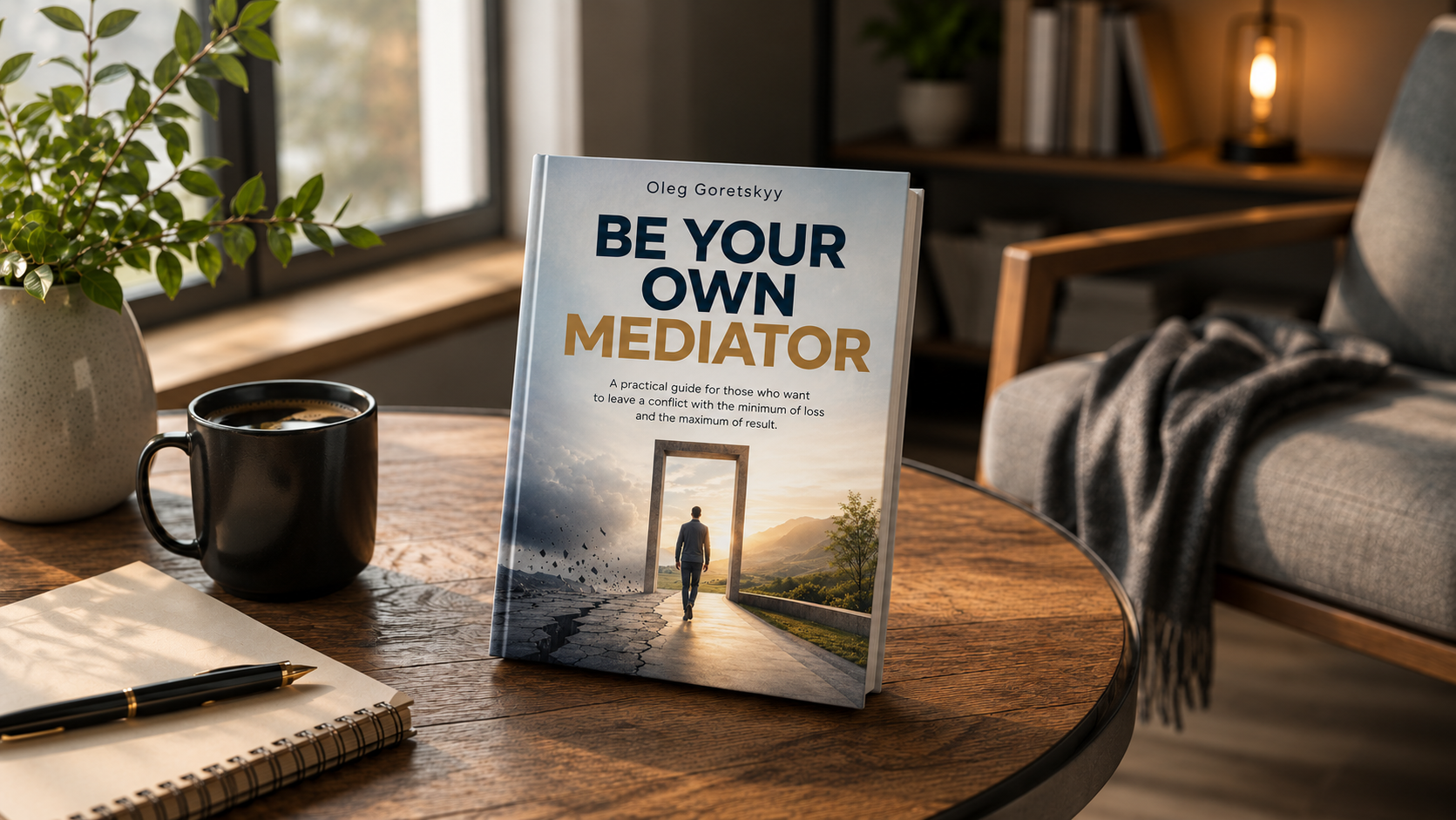
The practical tools for this work — how to calculate the real cost of a dispute, determine your BATNA, and build an agreement that holds — are set out in the guide “Be Your Own Mediator,” available on Amazon.