
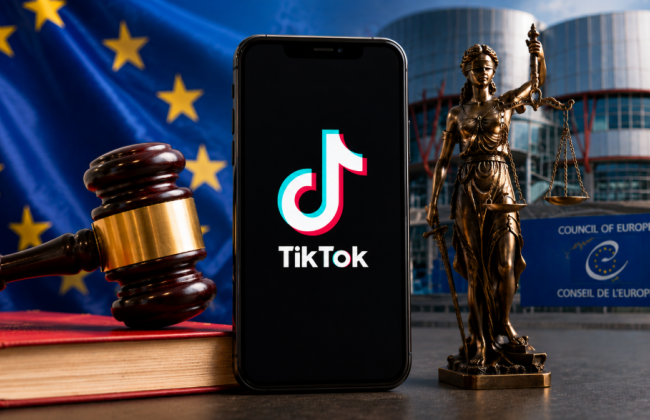
ECHR found a fine for an offensive video on TikTok legal: freedom of speech does not protect personal humiliation
/ 27 May 2026 14:58
3 min to read
Strasbourg Court Assesses Limits of Permissible Criticism of Officials on Social Media
The European Court of Human Rights has ruled that administrative punishment for a harsh and offensive video on TikTok does not violate freedom of expression if it is not about political criticism, but about personal humiliation of officials. The Court reached this conclusion in its decision in the case of Miladze v. Georgia dated May 19, 2026.
Courier recorded viral video about transport reform
A food delivery courier from Georgia applied to the Court, who in December 2022 published a video on TikTok criticizing Tbilisi’s transport policy and the work of the city authorities. The video quickly went viral – it gained more than 100 thousand views and about 600 shares.
In the recording, the man emotionally expressed his dissatisfaction with the public transport reform, bus lanes and the actions of officials. At the same time, a significant part of the video contained obscene language and personal insults directed at the mayor of Tbilisi, administration employees and law enforcement officers.
TikTok recognized as “public space”
After publication, the police opened administrative proceedings, believing that the content violated public order. National courts agreed that TikTok can be considered a public space, since social networks have a significant impact on society and public order.
The Tbilisi City Court found the man guilty of violating public order and insulting law enforcement officers and fined him 2,000 GEL — approximately 720 euros at the time.
ECHR: freedom of speech does not mean the right to insult
Strasbourg recognized that the video partly concerned a socially important topic — transport reform and the activities of the authorities. However, the Court drew attention to the fact that a significant part of the statements did not contain reasoned criticism, but were aimed at humiliating specific individuals.
The ECtHR stressed that freedom of expression does not protect unfounded personal insults, even if they are made in the context of a political debate. The Court also stressed that civil servants have the right to the protection of their dignity in the performance of their official duties.
The Court took into account the extent of the distribution of the video
The Court paid particular attention to the way in which the content was distributed. The video was publicly available and actively promoted by TikTok’s algorithms. In the ECtHR’s opinion, this significantly amplified the impact of the statements and increased the risk of their negative impact.
The Court noted that the Internet and social networks are capable of instantly distributing content to a large audience, including minors, and therefore states may apply a stricter approach to liability for offensive or illegal statements.
The Court did not see a violation of Article 10 of the Convention
As a result, the ECHR concluded that the fine was proportionate: the content was not blocked, additional sanctions were not applied, and the punishment itself did not create an excessive “chilling effect” on freedom of expression.
In view of this, the Court found that the state interference was justified and did not violate Article 10 of the Convention for the Protection of Human Rights and Fundamental Freedoms.
Without an author