
International Commercial Mediation: The Singapore Model and Why It Works Where Others Fall Short
/ 19 May 2026 19:26
12 min to read
When two companies from opposite ends of the world cannot reach an agreement, they typically go to court or arbitration. For years. Spending millions in legal fees. And in the end they receive a decision that one party has lost — along with which they often lose their partner, their reputation, and any desire to do business in that region again. Singapore decided things didn’t have to work this way — and built an alternative.
The Singapore International Mediation Centre is not just another legal institution with an attractive website and a panel of distinguished arbitrators. It is an attempt to rethink the very logic of resolving international business disputes: not “who will win,” but “how can both parties exit the situation with minimal losses and, ideally, with the partnership preserved.” Over ten years, the centre grew from six cases per year to a portfolio of disputes worth 7.6 billion Singapore dollars. This is no longer an experiment — it is infrastructure.
Why Singapore — and how SIMC came to be
Asia’s economic boom over recent decades generated not only new markets and new partnerships — it generated an avalanche of conflicts. Companies from different jurisdictions, with different legal traditions of common law and civil law, increasingly faced disputes that could not be resolved either in national courts or through standard arbitration without enormous expenditures of time and money. Singapore’s arbitration centre SIAC was founded back in 1991 — precisely to capitalise on this demand. But arbitration, although more efficient than litigation, still remains expensive, time-consuming and public. More importantly, it produces a decision that one party loses. For business, where partnership relationships have long-term value, this often means not merely losing a case, but the permanent end of a relationship.
In April 2013, Singapore’s Chief Justice Sundaresh Menon and the Ministry of Law initiated the work of a special working group led by Edwin Glasgow CBE QC and George Lim SC. The task was clearly formulated: assess the needs of international business and develop recommendations for transforming Singapore into a centre for international commercial mediation. The group’s findings were unambiguous — arbitration and courts cannot satisfy this demand on their own. A new type of institution was needed: with an international panel of mediators, flexible rules and the ability to integrate with arbitration procedures. On 5 November 2014, SIMC was officially launched by the Chief Justice and Minister of Law K. Shanmugam. Simultaneously, the Singapore International Mediation Institute SIMI began operations — as the body responsible for mediator accreditation standards. Two institutions launched on the same day — not by chance, but as a deliberate act of ecosystem-building from the very start.
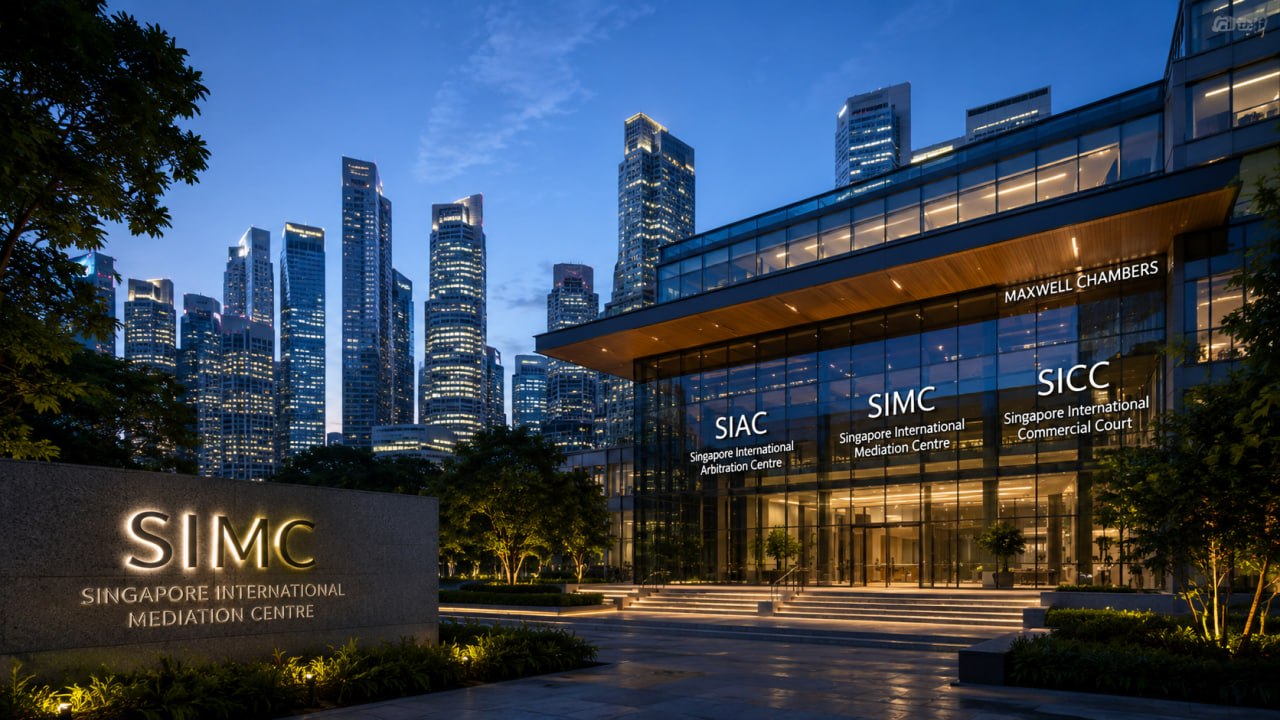
Today SIMC is part of a carefully considered triad of institutions. SIAC handles arbitration, the Singapore International Commercial Court SICC handles judicial procedures, and SIMC handles mediation. Together they form what is commonly described as a complete dispute resolution package for international business. Physically, this triad is housed in Maxwell Chambers — a building that has become a symbol of Singapore’s legal infrastructure. The offices of SIMC and SIAC are situated side by side, reflecting not only logistical convenience but a deep institutional relationship between the two organisations, realised primarily through the Arb-Med-Arb protocol. “We offer SIMC as a potentially good second choice for businesses,” notes the centre’s CEO Chua Wei Meng. “We are a neutral third party that companies can turn to. We have a judicial system that commands great respect in the world.”
How it works from the inside: from application to agreement
The mediation process at SIMC is structured with the realities of international business in mind — where parties may be in different time zones, speak different languages and have fundamentally different legal traditions. A case is initiated by filing an application with the secretariat. The centre then helps the parties select a mediator from the international panel — or appoints one independently if the parties cannot agree. The SIMC panel comprises around 70 mediators from 14 jurisdictions, each of whom is certified by SIMI. Among them are Singapore Ambassador Tommy Koh and William Ury, one of the world’s most renowned negotiation theorists and co-author of Getting to Yes.
A significant innovation of SIMC is that the mediator profiles on the centre’s website include a detailed description of each specialist’s approach. This allows parties to make an informed choice: a mediator with a “facilitative” approach will focus on building relationships and help the parties find a solution themselves, while a mediator with an “evaluative” approach — typically a lawyer with extensive experience — will help assess the legal positions and the realism of each party’s demands. Different conflicts require different approaches, and the ability to make an informed choice of mediator is critically important for the effectiveness of the process. Once a mediator is appointed, the timing and format of sessions are determined — ranging from short one-day meetings to multi-day negotiations. For technically complex disputes in intellectual property, patents, technology or media, SIMC can engage industry experts who help the mediator and parties understand the specifics of the subject matter.
What this process looks like in practice is well illustrated by one SIMC case: a multinational trading company and a manufacturing company clashed over the quality of delivered goods. The buyer refused to pay, and the seller initiated arbitration at SIAC. Under the Arb-Med-Arb protocol, the case was transferred to mediation — and an additional complication arose: neither party was represented by persons with authority to make decisions. Representatives with limited authority were forced to constantly clear every step with management, substantially slowing the process. In this situation, the legal advisors to the parties played a key role: they took on the function of driving the negotiations forward, combining the protection of their clients’ interests with a readiness to seek compromise. The mediator, in turn, kept the process on a constructive track — intervening at moments of deadlock and offering objective perspectives that helped the parties see the situation more broadly. In the end, an agreement was reached.
A more detailed account of the specific tools involved in this work — how a mediator structures the process, keeps parties in constructive dialogue and works with different levels of conflict simultaneously — is provided by Oleh Horetskyi in his book “Mediation: Ukrainian Experience and European Choice”, available in paperback and in digital format on Apple Books.
The Arb-Med-Arb Protocol: when arbitration and mediation work together
The most original contribution of SIMC to international dispute resolution practice is the Arb-Med-Arb protocol — a mechanism that combines arbitration and mediation into a single, coherent procedure. The logic is simple, but the consequences are far-reaching. A party initiates arbitration at SIAC. After the tribunal is constituted, proceedings are suspended and the case is transferred to SIMC for mediation. If mediation is successful, the settlement can be recorded as a consent arbitration award and becomes enforceable in approximately 150 countries that are parties to the New York Convention. If mediation yields no result, the arbitration proceedings simply resume. The parties lose nothing except the time spent on mediation — but that time could have saved years of arbitration.
The key distinction between this approach and traditional Med-Arb is that the mediator and arbitrator are different people, appointed by different institutions. This eliminates the classic Med-Arb problem, where parties are reluctant to share confidential information with the mediator knowing that the same person may later act as arbitrator and use that knowledge when issuing a decision. Under the Arb-Med-Arb protocol, no such risk exists: the mediation process remains fully confidential regardless of whether it ends in agreement. Singapore’s courts have consistently supported this approach. In the case of International Research Corp PLC v Lufthansa Systems Asia Pacific, the Singapore Court of Appeal confirmed the binding nature of multi-tiered dispute resolution clauses and emphasised that if parties have clearly specified a particular procedure as a precondition for arbitration, that procedure must be followed.
Crypto, family offices and the Belt and Road: what disputes SIMC resolves
Over ten years of operation, SIMC has developed a clear understanding of which types of conflicts are most amenable to mediation in the international context — and this picture is constantly changing along with the global economy. Traditional cross-border commercial disputes remain the foundation: conflicts between suppliers and buyers, disputes over contract performance, licensing conflicts, intellectual property and technology disputes. But alongside these, new categories are emerging that barely existed a few years ago or lacked their current scale.
Cryptocurrency disputes have become one of the most dynamic categories. According to SIMC’s CEO Chua Wei Meng, these cases have particular characteristics: legal frameworks in different jurisdictions cannot keep pace with the speed of technological development, and the volatility of crypto assets makes the speed of dispute resolution critically important. While an asset is losing value or frozen in legal proceedings, both parties lose. Mediation, which typically takes weeks rather than years, becomes the obvious choice in such a situation. Family office disputes are another rapidly growing segment, driven by the proliferation of large Asian family fortunes requiring professional management. Family member conflicts here take the form of complex commercial disputes with enormous sums at stake — but behind them always lies what financial statements cannot capture: family ties, shared history, a desire to preserve relationships even after a serious conflict. SIMC has already successfully resolved cases between siblings and between different generations of prominent Asian families. A fourth category consists of state-related disputes, including those arising under China’s Belt and Road Initiative. These cases are particularly complex due to the multiplicity of stakeholders and the long-term nature of the relationships: states, state-owned enterprises and private business engaged in the same project have fundamentally different interests — and they will all continue to interact after the conflict is resolved. Arbitration that delivers a decision in favour of one party often resolves the current dispute at the cost of future relationships. Mediation offers a chance to preserve both.
The Singapore Convention: mediation receives international recognition
For a long time, international mediation suffered from a fundamental problem that substantially limited its attractiveness compared to arbitration: the enforceability of settlements. An arbitral award is enforceable in 150 countries thanks to the 1958 New York Convention. A mediated settlement agreement was not. A company that reached a settlement through mediation might find that if the counterparty breached the agreement, it would have to begin a new judicial or arbitration process to compel performance. This substantially undermined the value of a mediated outcome — particularly in cross-border disputes where parties are located in different jurisdictions.
The Singapore Convention on Mediation, developed under the auspices of UNCITRAL, resolved this problem. The Convention was adopted on 20 December 2018 and opened for signature on 7 August 2019 in Singapore. On the day of signing, 46 countries signed — a record for UNCITRAL conventions. This attests not only to Singapore’s authority as a venue, but to genuine demand from international business for reliable mechanisms for enforcing mediated settlements. A mediated settlement agreement reached with the participation of an accredited mediator and in accordance with established procedures can now be enforced in signatory countries in the same way as an arbitral award. This eliminates the last serious argument in favour of arbitration in situations where mediation is the more appropriate instrument.
What SIMC means for Ukraine
The Singapore model is relevant to Ukraine in at least two dimensions — both entirely practical rather than abstractly theoretical. The first: Ukrainian companies doing business in international markets or involved in cross-border contracts already face the need to resolve disputes in neutral jurisdictions. Understanding how institutions such as SIMC operate, what tools they use and why the Arb-Med-Arb protocol may be more advantageous than standard arbitration is part of the basic business literacy required of those working with international partners.
The second dimension is systemic, and it concerns not individual companies but the country as a whole. SIMC demonstrates how mediation can become not merely a tool for “reconciling parties” but a fully-fledged infrastructure for international business. Singapore built this infrastructure consistently and patiently: first the arbitration centre, then the mediation centre, simultaneously an institute of mediator standards, legislative foundations, an international convention. Each element reinforces the others, and together they form a system that companies around the world trust. For Ukraine, which faces the task of post-war reconstruction and will need to attract significant foreign investment, the question of trust in dispute resolution mechanisms is not abstract. An investor considering investment in Ukrainian projects weighs not only profitability but also what will happen in the event of a conflict. The availability of reliable, predictable and internationally recognised dispute resolution mechanisms is part of the investment climate — and the SIMC experience shows how such a system is built not in a single year, but with clear logic and consistency.
In lieu of a conclusion
From six cases in 2014 to disputes worth 7.6 billion dollars in 2025 — this journey was made by SIMC not thanks to a single good idea, but thanks to the consistent construction of an ecosystem: rules, a mediator panel, the Arb-Med-Arb protocol, accreditation standards, an international convention. Each element made the next one more effective.
For business, SIMC offers what neither court nor arbitration can provide: control over the process and the outcome, confidentiality, flexibility and the possibility of exiting a conflict not only with an agreement, but with a preserved partnership. In a world where cross-border relationships are becoming the norm rather than the exception, this is not a luxury — it is pragmatism. Mediation does not replace law. It fills the space between what the law can resolve and what business actually needs. And SIMC has demonstrated that this space can be institutionalised, standardised and scaled — to billions of dollars and dozens of jurisdictions.