
Mediation: The Art of Reaching Agreement in Difficult Conflicts
/ 16 April 2026 09:23
14 min to read
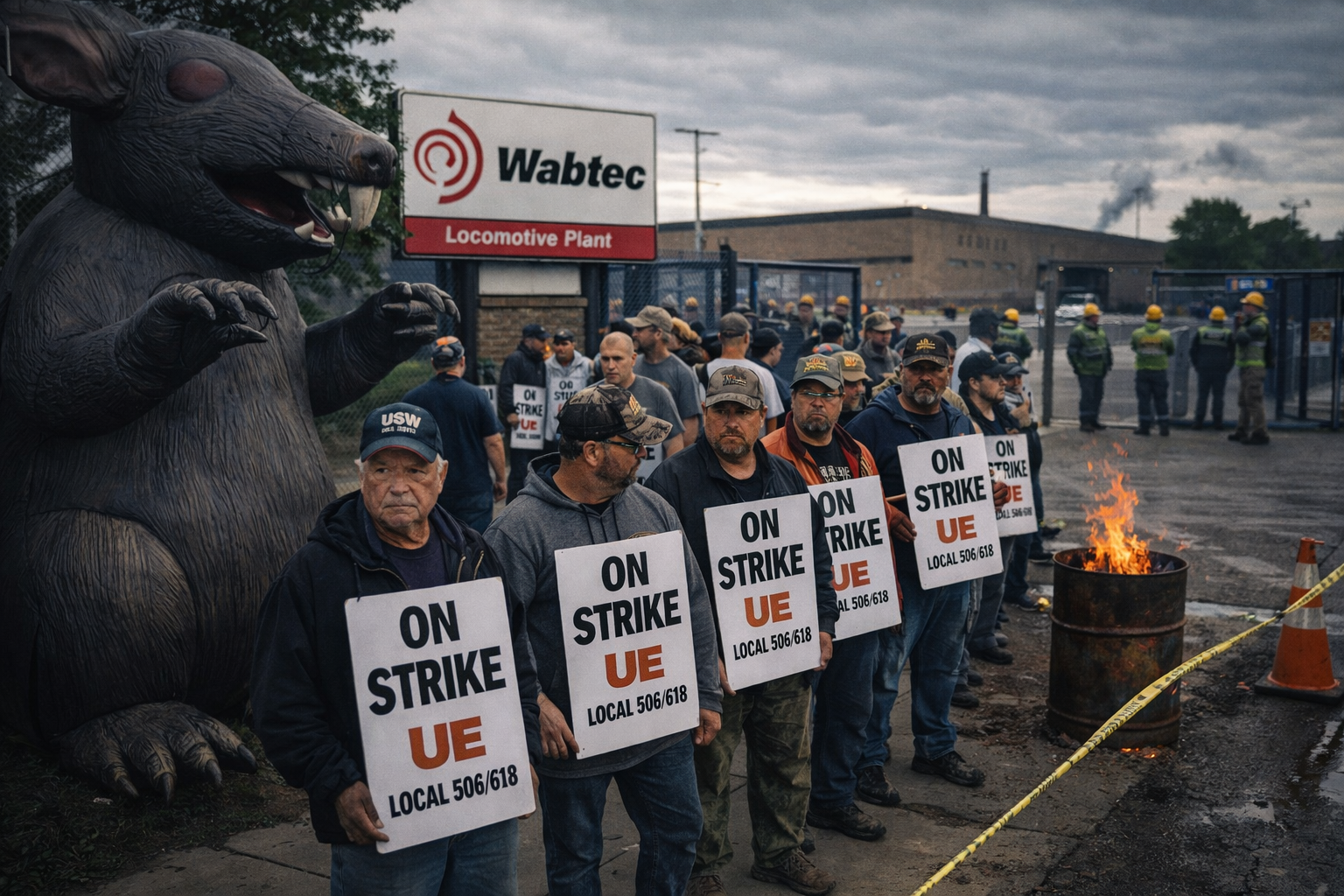
In the summer of 2023, the small city of Erie, Pennsylvania, became the scene of one of the most prominent labor conflicts in American industry in recent years. Fourteen hundred members of the United Electrical, Radio and Machine Workers of America (UE) walked off the floor of Wabtec Corporation’s locomotive manufacturing plant and took to the picket lines — around the clock, for seventy days straight. An inflatable rat appeared at the gates — the traditional symbol of American union protest, signaling the use of strikebreakers. The local economy felt the blow: 1,400 families without paychecks meant a measurable drop in revenue for local shops, restaurants, and service businesses.
But this story is interesting not merely as a chronicle of a strike. It is a detailed illustration of how federal mediation in the United States transforms what appears to be an irreconcilable standoff into a negotiating process — one that produces an agreement both sides consider better than their opening positions. And of why sixteen rounds of talks with FMCS mediators achieved what months of direct bargaining had failed to deliver.
Background: Why the Strike Became Inevitable
To understand the nature of the conflict, one must go back to February 2019 — the moment that many plant workers in Erie came to see as the starting point of accumulated grievance.
Before 2019, the plant had belonged to GE Transportation, the General Electric division that manufactured freight locomotives. For the city of Erie, the facility was not merely an employer but a symbol of industrial identity: for decades, thousands of families in the region had tied their livelihoods to this plant. When Pittsburgh-based Wabtec Corporation acquired GE Transportation, the situation changed sharply.
As early as 2019, within months of the acquisition, the union staged a nine-day strike: the new company wanted to renegotiate the terms of the collective bargaining agreement. That first walkout served as a warning — one from which both sides appear to have drawn very different conclusions. For the union, it confirmed that Wabtec needed to be met with firmness. For the company, it may have signaled that a certain degree of pressure on the union was acceptable.
At the center of the conflict stood a two-tier wage scale. Under this system, new employees started at a substantially lower rate and rose gradually over ten years toward the level earned by legacy workers with seniority. The specific figures speak for themselves: an experienced production technician earned $32.67 an hour, while a newly hired worker received just $21.47 — less than two-thirds of a colleague’s wage for identical work. Over the following decade, the new hire would gain roughly one dollar per hour each year.
The UE considered this system unfair and discriminatory toward junior workers, and demanded its elimination. Wabtec refused — arguing that the two-tier scale was company policy and provided necessary control over labor costs. These positions proved irreconcilable after six months of bargaining.
The Breaking Point: The Vote of June 22
On June 22, 2023, union members voted to reject Wabtec’s “last, best, and final offer” and to strike immediately. The margin in favor of striking was decisive.
The next day, pickets went up at every entrance to the plant. The inflatable rat appeared — a protest against the strikebreakers the company was hiring to maintain production. What followed would enter the memory of Erie residents as “the summer on the picket line.”
The strike immediately drew support far beyond Pennsylvania. Union leaders and elected officials from across the country traveled to Erie to express solidarity. The conflict went national — not only because of the size of the plant but because the two-tier wage question touched a raw nerve about inequality between legacy and new workers that is relevant across much of American manufacturing.
On August 3, the Erie County Court of Common Pleas issued a consent decree establishing limits on the number of picketers permitted at the plant gates at any one time. This was the legal resolution of clashes between strikers and strikebreakers. The decree itself is a small illustration of micro-mediation within a larger conflict: rather than proceeding to full litigation, the parties agreed to restrictions that satisfied both the company’s need for operational security and the union’s right to picket.
FMCS: The Federal Mediator Who Arrived Before the Strike
The Federal Mediation and Conciliation Service (FMCS) is a U.S. federal agency established in 1947 that specializes in mediating labor disputes. Unlike judicial or arbitration procedures, participation in FMCS mediation is voluntary and does not bind either party to any outcome. FMCS mediators serve as neutral facilitators whose role is to help the parties find an agreement on their own.
In the Wabtec case, FMCS became involved in the negotiations on June 5 — nearly three weeks before the strike. Mediators conducted three full days of talks with both sides before the vote of June 22. Those efforts did not prevent the strike — but they laid the foundation for what followed, and, crucially, preserved the credibility of the mediators with both parties.
After the strike began, FMCS did not step back. Over more than two months, mediators conducted sixteen rounds of negotiations between June and August 2023. That is an intensive pace — averaging roughly two sessions per week throughout the strike. Each session required preparation, structuring, and the effort of keeping both sides in a mode of constructive dialogue even as emotions on the picket lines ran hot.
The mechanics of how a mediator keeps the process productive even in conditions of acute public confrontation — and the specific tools available for doing so — are explored in my book Mediation: Ukrainian Experience and European Choice, available on Apple Books.
The Mechanics of Mediation: What the FMCS Mediators Did
From the outside, a strike looks like a binary situation: either the company yields or the union does. In reality, behind the scenes of FMCS-guided negotiations, a complex, multi-dimensional process was underway.
The mediators faced several layers of conflict simultaneously. The first was economic: wages, bonuses, cost-of-living adjustments. The second was structural: the two-tier scale, which both sides had elevated to a matter of principle. The third was emotional: the grievances accumulated since 2019, the sense that the new owner did not respect the plant’s traditions or its people. The fourth was reputational: the public nature of the strike meant that any concession instantly became a public fact.
The classic mistake in such situations is to try to resolve all layers at once, or to focus exclusively on the economic differences while ignoring the emotional and symbolic dimensions. The FMCS mediators, judging by the outcome, chose a different approach: they separated the issues into distinct tracks and worked each at its own pace.
The grievance procedure — the process for handling worker complaints and labor disputes — became one of the unexpected focal points. On its face, this is not the most obvious subject for mediation during a strike. But it was precisely here that years of frustration had accumulated: Wabtec’s grievance procedures differed substantially from what had existed under GE, and many workers felt their complaints were simply being ignored. Improving the grievance process became part of the final agreement — and not by accident. The mediators recognized that behind the technical procedural demands lay a deeper need for respect and recognition.
The two-tier wage scale remained the most difficult question until the end. The union wanted it eliminated. Wabtec wanted it preserved. The compromise both sides ultimately accepted left the scale in place but substantially improved the overall compensation package: a $1,500 signing bonus, an immediate wage increase of 3.65%, and further increases in the following three years — 3%, 3.25%, and 3% respectively. The agreement also included a cost-of-living adjustment: one cent per hour for every 0.017429% increase in the Consumer Price Index.
For the union, the survival of the two-tier scale was a defeat at the level of stated position. But at the level of the underlying interests — decent pay for all members and improved conditions for new workers — the agreement delivered concrete gains. That distinction between position and interest is the heart of the mediation approach.
Silence as Signal: How the Parties Showed They Were Ready for a Deal
One of the most instructive aspects of this case is the communications dynamic between the parties during negotiations. For most of the summer, both Wabtec and UE had been posting regular updates for their respective audiences — the company for shareholders and the public, the union for its members and allies.
In mid-August, those updates suddenly stopped. Wabtec posted nothing after August 17. The union went quiet after August 18. The silence lasted several days — and it said more than any official statement could.
Experienced observers of labor negotiations know this signal well: when both sides stop playing to the public, it means something serious is happening behind closed doors. Public rhetoric during a strike is always partly a performance for one’s own members and allies. When it goes quiet, that signals either a breakdown — or, more often, an approach to agreement.
The silence ended on August 30, with the announcement of a tentative agreement. On August 31, the union voted to ratify it. On September 5, fourteen hundred workers walked back through the gates of the Erie plant.
Exactly ten weeks had passed from the first day on the picket line to the return to work.
What Each Side Gained
Union president Scott Slawson characterized the outcome tersely: the agreement “represents a significant improvement over what Wabtec was offering in June.” He underscored the “determination of the members over 70 days on the picket line” and the fact that the strike had produced both economic and non-economic gains.
Wabtec, for its part, emphasized that the agreement “provides wage increases, improves the grievance process, improves vacation and personal time for new employees, and transitions the Erie workforce to the standard Wabtec benefits package with additional enhancements new to union members.”
Tellingly, after the mediation concluded successfully, the company proposed involving FMCS in the future to work through the large backlog of accumulated grievances. This is a highly unusual step: an employer that has just come through a painful strike voluntarily inviting the same federal mediator to handle ongoing labor issues. It indicates that the FMCS-led process did not merely end the strike — it restored enough trust between the parties to support a continuing constructive relationship.
For the city of Erie, the agreement carried an additional dimension. James Grunke, president and CEO of the Erie Regional Chamber and Growth Partnership, acknowledged that he had been worried throughout the negotiations about how things might end: “I was trying to make it clear that Wabtec has to make serious decisions about where to invest. Without a resolution, I saw the possibility that they would close the Erie plant.” The agreement removed that threat — and with it, preserved 2,400 jobs in the region.
Why Mediation Succeeded Where Direct Bargaining Had Failed
The natural question is this: if FMCS became involved three weeks before the strike and conducted three days of talks before June 22 — why did the strike happen anyway? And what changed over those ten weeks that made an agreement possible?
The answer lies in the psychological dynamics of labor conflict. Before June 22, neither side had yet been through the experience of real confrontation. Wabtec may have underestimated the union’s resolve and assumed its “last, best, and final offer” would be accepted. The union may not have fully grasped what a real strike would cost its members.
Ten weeks on the picket line changed that picture fundamentally. Both sides had now lived through real costs: 1,400 families without wages, a company with reduced output and reputational damage, a local economy under strain. This reality check created what negotiation theorists call “conflict ripeness” — the moment at which both parties understand that the alternative to an agreement is worse than the agreement itself.
Throughout that period, FMCS mediators continued meeting with the parties, keeping channels of communication open and gradually narrowing the distance between positions. Sixteen rounds of negotiations is not just sixteen sessions. Each round included separate meetings with each side, in which mediators could speak candidly about the realism of stated positions and about what could actually be achieved at the table.
It was precisely this combination — conflict ripeness plus the sustained presence of a neutral facilitator — that created the conditions for success.
Lessons for Mediation Practice
The Wabtec/UE case offers several lessons with broad relevance for mediation practitioners.
First: early involvement of a mediator does not always prevent a strike — but it always makes resolution easier. FMCS became involved three weeks before the strike and could not stop it. But that early presence meant that when the strike began, the mediators already understood the nature of the conflict, knew the key figures on both sides, and had established trust. Those factors proved decisive in the speed with which agreement was ultimately reached.
Second: a mediator in a prolonged conflict serves a “holding the space” function — even when agreement seems impossible. Sixteen rounds of talks over two months is not only a search for specific compromises. It is a demonstration to both sides that the negotiating process has not stopped, that a path to agreement exists, and that the mediator continues to believe in its possibility. This function is critical in drawn-out conflicts, where accumulated fatigue and frustration can lead parties to abandon the process entirely.
Third: symbolic issues require symbolic solutions. The two-tier wage scale was less significant financially than the general wage increases and the signing bonus. But it was a symbol of the company’s attitude toward new workers — and that is precisely why it became such a powerful focal point of the conflict. Keeping the scale while substantially improving the overall package allowed both sides to save face: Wabtec had not “retreated” on a matter of principle; UE had obtained real improvements for its members.
Fourth: trust between mediator and parties is an asset that accumulates over time. The fact that Wabtec, after the strike ended, invited FMCS to work through the backlog of accumulated grievances is the clearest possible evidence of the quality of the mediation process. The mediators did not merely resolve a specific dispute — they built relationships with both parties that would outlast the conflict and become a resource for the future.
Conclusion
The strike at Wabtec’s Erie plant lasted ten weeks and ended with an agreement that both sides described as an improvement over their opening positions. For the 1,400 union members, it meant returning to work under a better contract. For Wabtec, it meant restoring normal production and keeping the Erie plant open. For the city, it meant preserving 2,400 jobs and economic stability.
Behind that outcome lie sixteen rounds of negotiations under the guidance of federal FMCS mediators — invisible work that rarely makes headlines, but determines whether a confrontation becomes an agreement.
The Federal Mediation and Conciliation Service has no power to compel either party to agree. It cannot prohibit a strike or force a company to accept union demands. All it can do is provide the space, the structure, and the neutral presence within which the parties find their own way to a resolution. In the Wabtec case, that was enough.
The inflatable rat was deflated and packed away. The picketers went home. On September 5, fourteen hundred workers walked through the gates of the Erie plant — and a better deal than the one they had been offered in June was waiting for them.