
A Conflict Is a Problem – and Problems Have Solutions: My New Guide Be Your Own Mediator
/ 8 June 2026 18:21
5 min to read
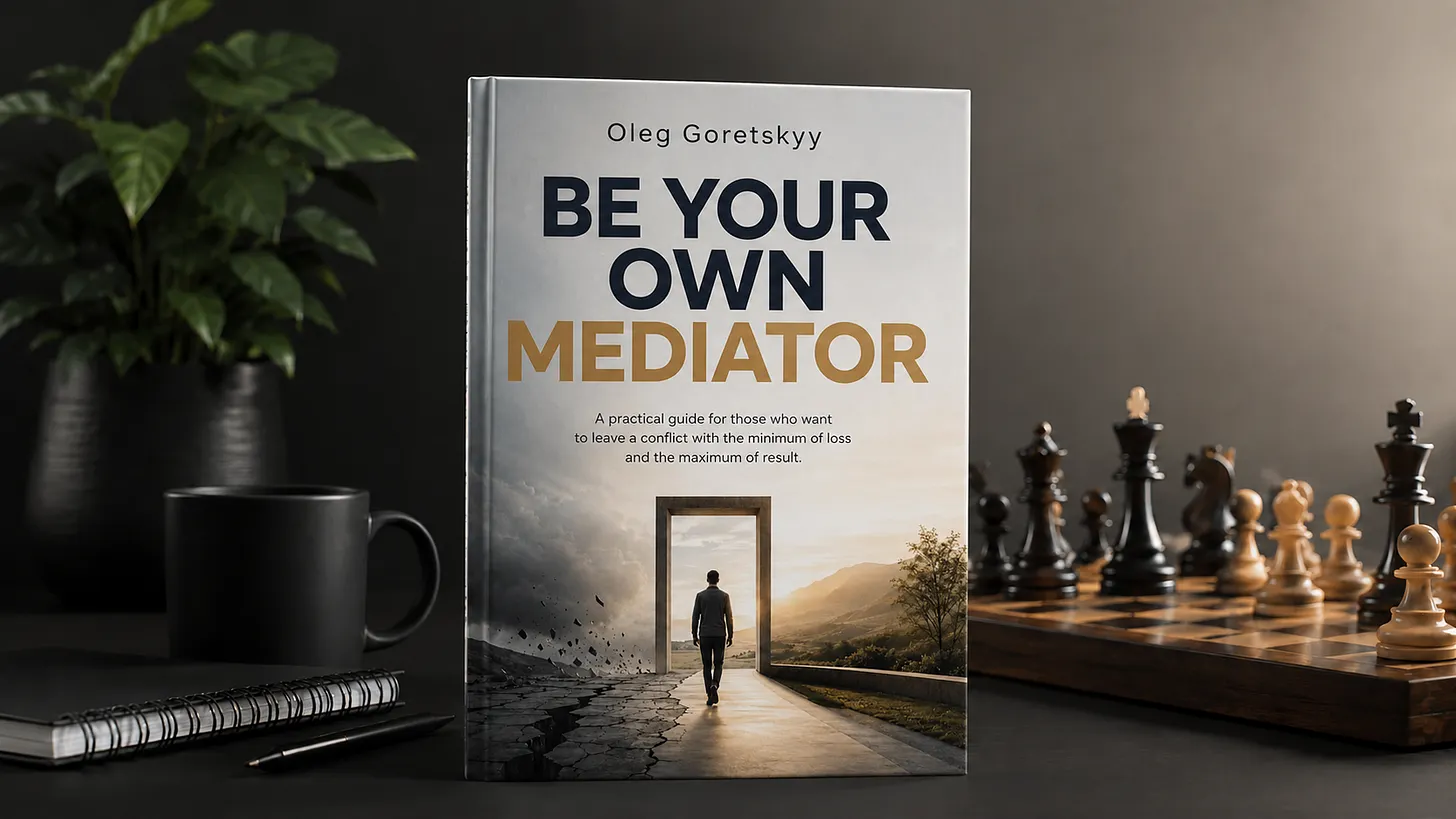
Conflicts are part of every life, but few people know how to get through them without unnecessary losses. As a practicing mediator and lawyer, I am reminded of this every day — and that is precisely why I write books on mediation for Ukrainian readers. The first was Mediation: Ukrainian Experience and European Choice, in which I tried to explain the very nature of this institution: where it comes from, how it works, and what European tradition stands behind our choice to adopt it. Today I am pleased to share that the second book in the series has been published: Be Your Own Mediator.
If the first book was about the system, this one is about the person in a specific conflict. It is considerably more pragmatic. I did not write it to convince anyone to “be kinder” or to “compromise for the sake of peace.” I wrote it for people who count.
Be Your Own Mediator is now available — on Amazon.
Mediation Is First and Foremost About Time and Money
There is a widespread misconception that mediation exists to help people “avoid conflicts” or “preserve relationships.” Sometimes that is true. But the point is not only that. Mediation is a way to resolve a dispute while bypassing the courts — and thereby preserving what costs most in Ukrainian realities: time and money.
Consider what “going to court” actually means in this country. Years of waiting — cases drag on endlessly because the courts are overloaded at multiples of European norms. Legal fees, filing costs, expert examinations. And above all, even a judgment in your favor guarantees nothing: in Ukraine, only one in four or five court decisions is enforced voluntarily. The rest require compulsion — which means a new process and new costs. A person can win a lawsuit four years later and discover that the business has gone bankrupt, the money has lost its value, and there is no energy left to enjoy the victory.
Mediation works differently. Instead of spending years establishing who is right, the parties find a solution that satisfies both sides’ interests in a few meetings. And — crucially — such a solution is complied with voluntarily in eighty to ninety percent of cases, because people readily honor what they have decided themselves rather than what has been imposed on them. This is not idealism. It is straightforward cost-benefit arithmetic. That is why I say the book is saturated with pragmatism: it teaches you to look at a conflict as a costly operation and to exit it with the best possible balance.
Why This Matters Right Now
Ukraine spent nearly twenty years moving toward a mediation law and finally adopted one at the end of 2021. But legislation is a beginning, not a conclusion. The institution will genuinely take hold only when the culture of dispute resolution changes from the bottom up — when an ordinary person, an entrepreneur, a family instinctively asks not “how do I win my court case” but “which path will cost me least.”
In developed legal systems, this has long been the norm: a large share of disputes are settled well before the courtroom. Not because people there are unusually kind — but because they have learned to count. We need to learn to count too, and not only for our own financial benefit. The more disputes are resolved outside the courts, the lighter the burden on the justice system itself — which means courts can devote attention to cases that genuinely require a court. Developing mediation is not only a personal gain for each party; it is a contribution to the relief and improvement of the entire legal system. I see my books as a small step in that direction.
Who This Book Is For
Be Your Own Mediator is written simultaneously for two audiences — for mediators and for the parties to a conflict themselves: the people who sit at the negotiating table. Whether the dispute involves an employer, a business partner, a neighbor, or a former spouse, the logic is the same. Since I am both a lawyer and a mediator, I wrote in a way that offers something to everyone: a party to a conflict will find tools to save years and money, while a mediator will find practical techniques for working with difficult counterparts.
Inside: the Harvard Negotiation Model adapted to the Ukrainian context; tools for calculating your own alternatives; an analysis of the cognitive traps that push us toward bad decisions; a typology of difficult opponents and responses to classic manipulation tactics; the mechanics of the mediation procedure itself — seen from the inside; and, separately, how to draft an agreement that will actually be honored. Each chapter closes with a practical section: exercises, checklists, and algorithms that can be applied to your own conflict today.
If the whole book can be distilled into a single thought, it is this: a conflict is not a tragedy. It is a problem. And like most problems, it has a solution — for those who think more clearly, calculate more honestly, and know the right tools.
I hope this book becomes one of those tools for you.